Showing posts with label Dystopian. Show all posts

Saturday, October 22, 2016

Saturday Revue Octobe 21st: Moses Jones,Apocalyptic Mama

A Girl's Gotta Do...

What A Girl's Gotta Do...

Modern parenting is hard, and it just keeps getting harder. Teething troubles. Deadbeat dads. Zombies?
But Moses Jones has four mouths to feed, Madonna the Katana and a lot of moxy. She isn't letting a few undead slow her down. 'Moses Jones: Apocalyptic Mama' is her story. Written by Em Mccarty, this is zombie dystopia as you've never seen it before.

The Rating

Hmmm....close, but no katana.

The Raves

At its best,  'Moses Jones' reminds me of  the art therapy journal of someone coping with trauma: raw, beautifully lucid and painfully candid. The story revolves around the deep emotional bonds Moses forms, and when it stays on those themes it's wise, moving and meaningful. The emotional content packed into the work is palpable even in the simplest phrases, and the piece really does make you feel for the characters when it stays focused.
The art style is a pen-and ink lucid dream, as raw in its execution as a piece of folk art and as bluntly powerful when at its best. Sacrificing finesse for emotion, it delivers a gut shot that reminds me of Cheyenne artwork: its stark simplicity doesn't give you any wiggle room. You have to face it head on. This story pulls no punches, in storytelling or in style.

The Razzes

Unfortunately, those powerful punches are often thrown with the finesse of a wild haymaker, and too often they miss the mark. I admire the style that Mccarty is aiming for: the wistful lucid dreaming of a sensitive woman in a dystopian world, coping with her issues through her art. But both the storytelling and the art have a long road ahead of them before they can support such a powerful tale.
Here's my advice: do a lot of study on the anatomy of the human face and head. Here's the basics:


1. The eyes sit at the vertical center of the head or just above, about halfway between the top of the skull (not the hairline) and the bottom of the chin.

2. The bottom of the nose (not the bottom of the nose tip, which can be angled however) sits halfway between the brow and the chin.

3. The ears stretch from the eyes to the bottom of the nose.

4. The width of the eyes is roughly 1/5 of the distance from outer ear to outer ear. In wider faces, this doesn't apply.

5. The eyes are one eye-width apart.

6. The width of the nostrils is the same as the width between the eyes.

7. The center of the lips is located 1/3 of the way down the distance between the bottom of the nose and the chin.

8. The width of the lips (from side to side) is roughly pupil to pupil.

Fix the faces and the rest of the art will look at least twice as good.
Now, storytelling is harder to fix, but  my main advice is this: KISS. Keep it simple sir. Too often, the storytelling rambles off hither and yon: into the lives of side characters who aren't even named at first, into the past, off to moon about an absent lover. All these storylines have their place, but they feel more like loosely connected strands than a story fabric. I understand that the creator is aiming for a personal journal feel, but sacrificing story for style is a cardinal sin of comic making. Tighten the story up, or you're going to lose your readers.

The Revue

I'm keeping my eye on this one. With a little more attention and practice, it'll be shooting off zombie heads at two hundred paces!


Saturday, July 16, 2016

Saturday Revue July 16: Stand Still, Stay Silent

What Do You Do When The Monsters Come?

Stand Still, Stay Silent

And Hope...

It seems like the world's always on the brink of  going to Hell. In the 20's it was the stock market crash, in the 40's it was WWII, in the sixties it was the Civil Rights abuses and the Movement that grew from them, in the 80's it was everything Billy Joel sang about in 'We Didn't Start the Fire'.  Now it's Brexit, economic downturns and civil rights abuses all over again.
But somehow, the world always makes it through disasters by the skin of its teeth.
This is the story of the day when it didn't. It's the story of the day after the end of the world, in the lands of ice, fire and forest.
This is Stand Still, Stay Silent, the creation of Minna Sundberg, and it is a thing of wonder and terror.

The Rating

A Wonder To Behold

The Raves


Let's begin with the plotting and storyline of this piece. This story explores the dystopian genre from a whole new direction, and it pulls off the feat with wit, charm, and a refreshing pragmatism.


To begin with, it's set in Iceland and rooted securely in Scandinavian ideals and mythos, which is hugely refreshing in a genre that has been dominated by baked American deserts and crumbling American super-cities.  It's been 90 years since the end of the old world. Most of the surviving population of the Known World live in Iceland, the largest safe area in existence.  The safe settlements in the other Nordic countries-Norway, Sweden, Denmark and Finland- are scarce.
 The tale begins in the first few days of the disastrous illness that will bring the world crashing down-you know, the stage where everybody says 'the government's just overreacting'?- and sets the stage quite nicely. Then it makes one of the most adroit suegeway passages I've seen.
That brings us to the present day, and an intreped set of explorers ready to rediscover and bring home the treasures left in the outer wastes of the Silent World. They're going to be up against some pretty tough odds too...
What I admire in the writing style is the calm, sensible pragmatism of the cultures involved. They didn't fall apart or devolve into barbarism, there's no marauders or crazy biker gangs. There is, instead, a concerted cultural drive to stick together and survive. People find ways to cope. People create a new normal. The understated 'can-do' attitude in this comic is something I really appreciated.

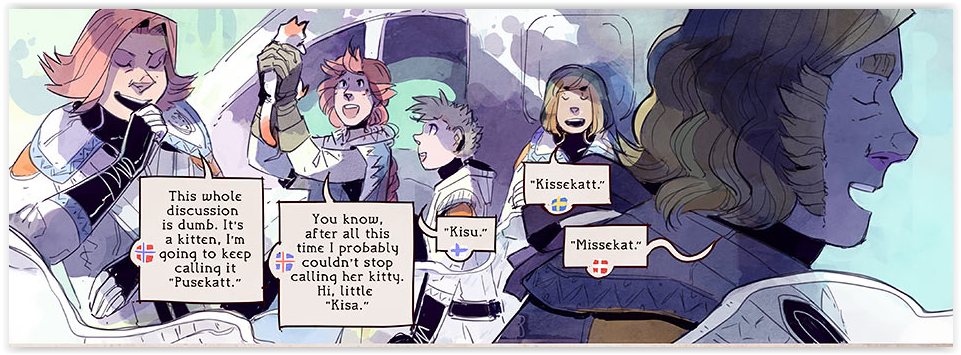
 It was also amusing to be given an insider's look at how the Scandinavian cultures view one another; what Americans view as a pretty homogenous group is actually teeming with little cultural differentiations for the discerning eye, amusingly pointed out by the characters and eye opening for the readers. There's a wonderful handling of getting the fact that there are multiple languages spoken across in a visual medium, not an easy feat, 


and a cast of characters you really come to think of like your siblings; amusing, ridiculous and endearing people who are just getting on with their lives.
The world building is so deftly done that you sink into the SSSS world without a ripple. The occasional page of exposition is done as a bulletin, a flyer, a page from a book, and it all belongs exactly where it is in the story.

Add to that the fact that the creator dribbles out information about the disease that brought down the world and the monsters that exist now at a tantalizingly slow rate, and you've got a great story.

And now that I've dissected the storyline in an eloquent and educated manner, let's talk about the art.
*ahem*
OHMYGOODNESSISSOPRETTY ISSALLSHINYILOOOOOOOOOVEIT!!!!!!!!!
This is, hands down, one of THE MOST BEAUTIFUL  comics I have ever seen. The creator's sense of all the basics goes without saying, and they go FAR beyond that. The textures are ASTOUNDING.  The artistry here is incomparable.
And to put the cherry on the cake, the use of traditional Scandinavian folk-art suffusing the daily lives of our characters gives this comic a profound depth and organic complexity. You feel as if you could live there.

The Razzes

....yeah, I got nothing. Zip. Nada. You could say it'd be nice to know a little earlier in the story when magic came back and why, how illness connects with monsters...but that'd spoil the mystery!

The Revue

Read. It. Today.


Sunday, July 3, 2016

Independence Weekend Review #2: Greenshift

Shift Yourselves! It's Time For


The world isn't going to hell in a handbasket. It's arrived. Now, what are you going to do about it?
That's the question Greenshift, the creation of Andrew Rodriguez, poses . When you're handed a choice of evils, what do you do?
You become something of a devil yourself.

Buckle in and hang on, it's going to be a bumpy ride.

The Rating

Sassy, stroppy and smart. Okay, you got my attention.

The Raves

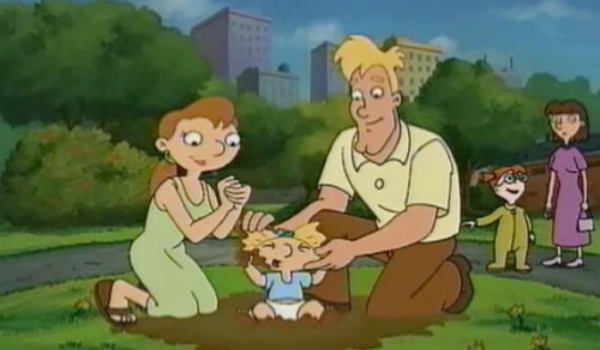
The feel of 'Greenshift' can best be explained like this: remember Hey Arnold? 
Okay, great. Now imagine that something very, very, VERY nasty happened to Arnold's city. Wait a hundred years, and what you might get is Green Shift.


Sure it's a mess, but it's home!
The story revolves around Max, a scrounger who lives on his wits and thinks on his feet. Max is all show, and so is Greenshift. This is the quintessential 'show, don't tell' story. We get no boring backstories, no lengthy expositions. Instead we get a world that speaks for itself and a character who we don't need a backstory for. Every action Max makes expands and enhances his personality, and every detail shown fleshes out the world around him. It's a masterfully realized tale, without an inch of wasted page space.
That isn't to say there isn't room in Greenshift for fun. It's the sassy humor that made me think of this as an adult and apocalyptic 'Hey Arnold'. The snarkiness is the perfect response to the heavy handed authoritarian forces who control Max's world, and a nice showcase of humanity coping even in the most dire of circumstances.
It's easy to despair in Dystopia. When your choices are what will kill you outside the wall (on the left) and what will crush you inside the wall (on the right) it'd be tempting to just lie down and give up.

but Rodriguez's creation is diametrically opposed to despair. It's a scrappy, feverishly energetic world full of characters who WANT TO LIVE, whatever that takes. No matter what the world throws at them, Max and his friends are not giving up and not backing down. They trick, they taunt, they write on the walls and they keep bouncing back every day. They dig through trash to find things to sell and sing on street corners. They flip the bird to the authorities and they push the envelope. And they keep trying to find something better. No matter what the world thinks, they know they're alive, and they're fighting to be free.

The color pallette is a perfect choice for the world portrayed, its hues at once intense and slightly skewed. The facial expressions and fluid body language of the main characters are delightful. Those eyebrows! And the backgrounds are wonderfully detailed, fully realized and organic, sometimes pretty intensely. There's a tactile sense to the drawing style of Greenshift, in the most disturbing of ways: seriously, you can almost smell the trash and the exhaust. Some interesting experiments were done with photomanipulation, and it was done well enough that I had to look twice to realize what media was employed. That's harder than it looks; I was impressed.
 And as a last note, the easter eggs all through the scenes are truly snicker worthy.

The Razzes

One thing I'd like to see worked on: while the body language of the main characters is well realized, a lot of background characters end up with stiff cylindrical torsos and rather wooden poses that detract from the appeal of large scenes. Often the faces will be perfectly rendered, but the body will have a rigidness that the clothing doesn't hide. Every character needs to be fully realized, or the discrepancy shows.

The Revue

Carry on my wayward son, I can't wait to see where this is going next.


Saturday, July 2, 2016

Independence Weekend Revue #1: Handicape

When Was The Last Time 

You Really Looked

 At The World Around You?

Look Up And Pay Attention To


It's so easy to go along accepting what happens in your life. You do your job, you get your pay, you take your breaks when you can. It's so easy to accept what you're given.
But do you have to?
That's the question at the heart of the comic Handicape, the creation of Red Tempest Media
Bound to his wheelchair, Ethan Stone doesn’t know about a deep and ancient conspiracy with its epicenter in the very town he lives in. As he learns that he has rare powers, he’ll have to discover his potential to overcome the dark conspirators and save the world.

The Rating

Powerful messages, deftly delivered


The Raves


Handicape asks the hard questions that our culture so often ducks or papers over: What makes us valuable? 
What makes us right? 
What makes us wrong?
What if the people in power 
have betrayed the people they serve?
What will you do about it?

   In flow and emotional content, the story is a blend of House of Cards and Daredevil (er, in a good way.  Without the ridiculous ethnic stereotyping. Sorry Daredevil fans, Russians don't start singing old folk songs as they're dying and all Asians aren't inscrutable)
 The events are deftly understated and thoughtful, layered with undercurrents. On the surface, it's simply the story of disenfranchisement and disenchantment. It's classic rebels without a cause fighting 'the man', right?
Look again. Look deeper. Look at who's pulling the strings.


That's what Andrew is intent on doing. Andrew is good friends with Ethan Stone, the wheelchair bound kid he's been close to since high school. School wasn't much good for Andrew and Ethan. Andrew got expelled under mysterious circumstances and Ethan...well, Ethan got some career advice. The kind that should get a teacher fired.
     

Their lives and their systematic disenfranchisement by those who would use them as pawns are laid out in slow, graceful arcs of image-based poetry that, as a reading experience, is a little like the most exquisite Chinese water torture. The tension just keeps building all the time, and there's no end in sight. The difference is, you don't want this tension to end.
The art style supports the story perfectly, the colors both bleak and rich. Character design, body language and facial expressions all add depth and nuance to the storyline, underlined when, at important junctures, the scene is stripped down to a pure watercolor style sans background and you're forced to pour all your attention into the characters. In this story, it really is about them: what the world does to them and what they choose to do in response. And what's that?
They choose to fight. Not with big, showy gestures: bombs and guns. That kind of physical fight is attractive because it's fast and easy. But the characters in Handicape fight with blogs, with information, and with what they have: their hope, their minds and their determination. They are ground down by the world every day, but they won't give up. They won't surrender to disability, to authority, or to dismissal. That is true bravery.

The Razzes

I have one request for the creators: please double check before you upload, you've got a handful of typos and wrong updates that bring down an otherwise pristine work.

The Revue

Ditch the caped crusader movies. Here's a story about real heroes: the quiet people who work every day to stop injustice.

Independence Weekend!

Announcing The Weekend Of Independence!

Raise Your Hands For

Handicapes!
Green Shift!


And Serious Engineering!

FREEDOM

Freedom. It's a word that gets bandied about an awful lot in America this time of year. We have fireworks and freedom and a few beers. That about covers it for most of us.
But what is freedom?

Freedom isn't patriotic songs. Freedom isn't cheering crowds and nice cars and wealth. Plenty of places where true freedom is scarce have all those things, sometimes in great abundance. The best way to hide a cage is to gild it.

So this weekend, let's ask ourselves this question:

What Does Freedom Mean To Me?

My answer is this: my freedom is in my choice. I choose what I do with my money, my time, my life. If I make a poor decision, I choose to accept the consequences. If I make a good decision, I'll reap the rewards.
But it's. My. Choice. Period.
Keeping the right to make your own choices is harder than it looks. Plenty of people in this world benefit when someone else is deprived of a real choice about what happens in their lives, and they do it in a thousand ways. Information is withheld, and people are tricked into false dilemmas. 

Information is warped, and people are coerced into false choices based on what they've been told. 
Freedom is the making of a choice. It's what the founders of America fought for: the right to choose the future they were working towards for themselves, rather than having it dictated to them. The right to choose who and what they would become. Americans fought to have a choice in our own lives. Every generation that came here from another country fought to find a place, fought for the freedom to make their lives what they wanted them to be.
Some of us are still fighting today. 
We're fighting for the right to choose our lives. 
We're fighting for the right to choose a better way to live, for ourselves and our children.
We're fighting to be seen as people who deserve a choice.

As a people, we Americans haven't always chosen right. In fact, sometimes we've been dead wrong.
But here's the thing: every day, we have the freedom to make new choices.

It's up to us to make them.

When we sit back and let someone else make the choices....well, read your history books. There's plenty of examples in them on what happens when we give up our choices.


This weekend, America celebrates its independence. In honor of our right and our responsibility to make the choices that will decide our future, we'll review three comics that remind us of this fact:

We have the ability-and the duty- to stand up, raise our heads, raise our voices.

We have the Freedom to make a Choice. We must use it.

Here's hoping these comics will give you insight. What you see in them is up to you.


Sunday, June 26, 2016

Backstage Pass June: Daniel Sharp


Hey, Guys! We Got You A Pass!

Let's Go Backstage And Meet Daniel Sharp!

So Dan, tell us about yourself!

Rockwell had it right 
I'm a husband, father, and MD/PhD student (school forever!). In my "spare" time I write our comic, volunteer as the Scoutmaster for the Boy Scout troop my church sponsors. 


Main Project

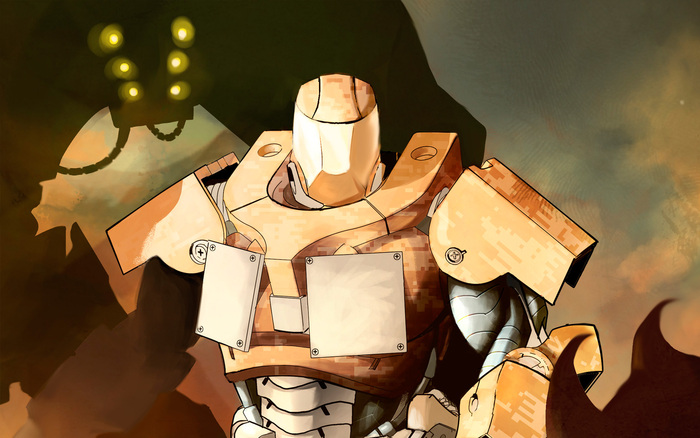
 The Demon Archives, a post-apocalyptic sci-fi story featuring powered armor and snarky AIs. 


Other Hobbies And Obsessions

 Alongside the classics of reading and video games, I guess, I recently discovered/decided that table top gaming (a la Dungeons and Dragons) is actually a rather enjoyable way to spend time with friends. So I run and play in a couple of games in person and even online with distant friends.


So, tell us about your early experience. How did you fall in love with telling stories in pictures?

  So, first off, I am not an artist. Horribly rendered stick figures are my forte. I am a writer, and work WITH a talented artist, Sebastian Piriz (http://sebasp.deviantart.com) to make our comic.
The mighty Seba
We got started when I took a creative writing class from Fantasy author Brandon Sanderson back in my last year of undergrad. My brother and I had been talking about this world/story, so I developed it into a novel. While working on that, I realized that my biggest weakness was in conveying the visual feel and setting of the story, and that it would be cool to have it as a graphic novel. So we ended up contacting and hiring Seba to draw it, and have been posting it online ever since.
The interesting Nick


What media and programs do you work in to produce your project?

This doesn't apply to me as much (Microsoft Word?), but I know that Seba uses Manga Studio and Photoshop for his inks and colors, respectively. We also make use of a site called Basecamp that allows us to coordinate effectively.


Can you tell me about your typical day or strip-creation session? How does your working process flow?

 I can't speak too much for Seba's visual process. Normally what we'll do is I'll plot out the chapter, giving it to him in chunks I think fit about a page. He is better at page and panel plotting than I, so normally he'll draw a quick sketch breaking it down visually. We'll talk about it, and he'll start doing inks while I finalize dialogue. Then he'll do the colors. It's a lot of back and forth.

Can you tell me about your storytelling process? Do you prefer to script your stories, fly by the seat of your pants, or somewhere in between?

In terms of the story planning, I initially wrote a large chunk of the story as a novel. We've since passed that point, and while I know where the story is going and have major plot points plotted out, I'm letting the story and characters grow a bit organically, one chapter at a time, for the most part. It allows me to make adjustments as I see a page, or as a reader makes a comment that makes me rethink something, etc. Plus, Seba often has great ideas for the story and characters.

You explore both the future of technology and the twists and turns of human psychology with amazing skill; your understanding of the concepts is some of the best out there. How do you go about researching ideas you'd like to use in your work?


 A lot of it just started with my brother and me chatting and spitballing about what the future could conceivably be like. While there is a lot of "rule of cool" in our choices, most of it is honestly just me extrapolating off of existing tech and possibilities. I'm rather well educated (school forever!), especially in the ability to read scientific journals and whatnot, and enjoy just thinking about things. I also try to recognize my limitations and look for expert counsel on topics I am unfamiliar with. Some of this is through books, much of it is from connecting with individuals online (in topic-oriented communities like reddit, for example).

Do your ideas grow from your reading, or do you get ideas and then research them?

 A little of both? Sometimes it's "man wouldn't it be cool if Tenzin's suit could do X? Let's look for the science about that!" Sometimes it's "Huh, neat! Scientists made prototype/proof of concept for Y. Given 100 years and some sci-fi, that could totally be Z. Let's give Tenzin Z." On average, probably more of the first variety.

What are some of your most reliable research sources?

Because of my scientific education, I feel rather confident in my ability to weed thru Google and Wikipedia to find good data. Often that means finding some popular science article and then delving past it to the original source material. Similar to how I tell my friends and family to let ME put their symptoms into WebMD, because I am more able to filter out the junk and find the useful tidbits.


What’s the most difficult part of your work?


The most difficult part for me is just making time for everything. Researching, writing, managing the site, the community interaction, advertising, marketing, etc. So much stuff to do for my hobby in my "spare" time not working on my degrees or spent with my family.


How much of a buffer do you like to keep? 


 Personally, I prefer having almost a full chapter of buffer. But a lot of that is out of my hands. Seba is a full time freelance illustrator. We can't pay him enough to work on our stuff full time (plus he'd get bored, and has his own stuff), so sometimes it's hard to keep a buffer going. Lately we've been going week to week.

What message do you hope readers take away from your work?


 Hmm, I'm not sure if I have any particular message I'm trying to get across. I'm mostly just trying to tell a fun story I came up with in what I imagine is a semi-plausible future. If people want to take away something, that's on them and how they engage with the story.

That said, there are definitely some themes I guess that we're trying to hit. Things like what it means to be a person, bodily autonomy, dealing with stress/depression/PTSD, thinking about a potential cybernetic future (iBrain, anyone?), etc. Readers are welcome to take away whatever conclusion and implication they want, I'm just presenting a story with themes and events I like. I often try to actually present multiple sides to these themes, as well.


What keeps you devoted to telling the story you’re telling?

 Can't stop now! If nothing else, I need to finish the current story, and have it all printed up on my shelf someday :)

Rock On, Dan and your awesome team. We look forward to the next big bang in your story!