Here's Your Pass!
Let's Slip Backstage And Meet
So Dylan, tell us a little about yourself!
Born in Colorado, grew up in Texas, moved to the UK, moved to Boston, moved back to Texas, and now back in Colorado. I think this means I have to move back to the UK next.
Main Projects:
Valley of the Silk Sky is my current main project, a graphic novel I'm serializing as a weekly-ish webcomic.
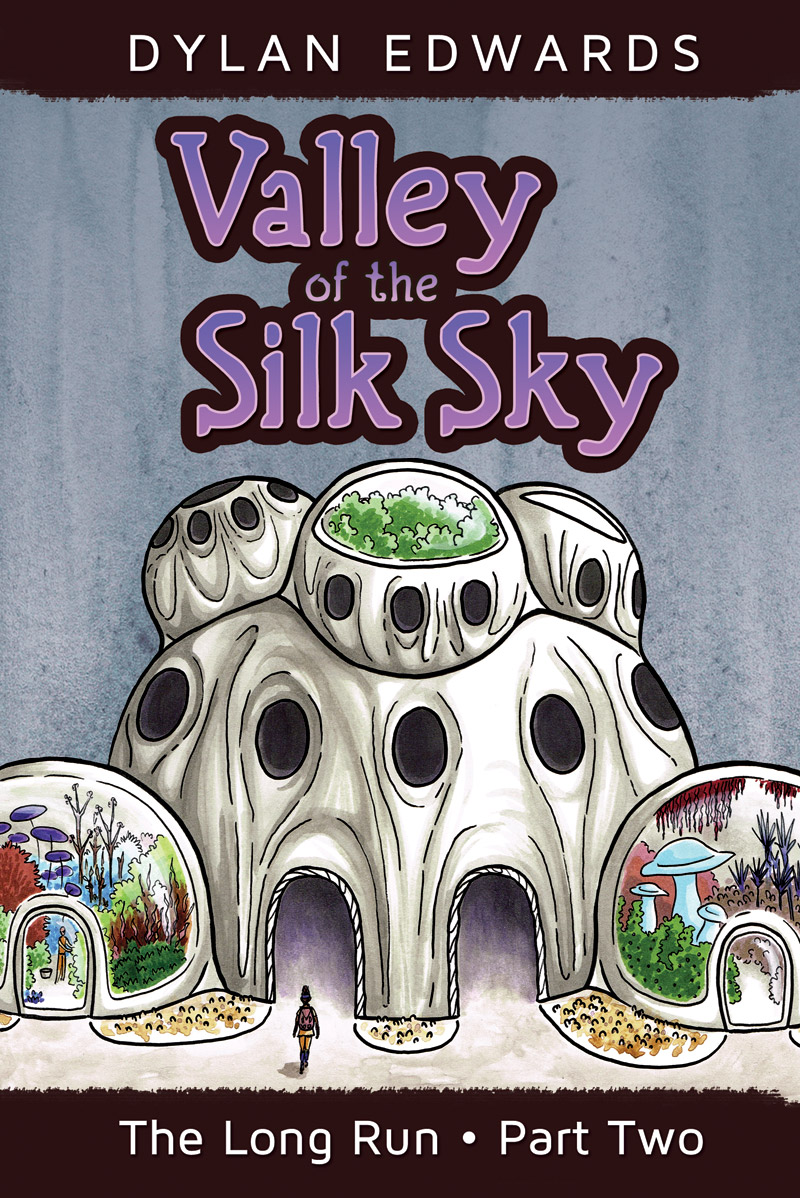 http://valleyofthesilksky.tumblr.com/
I've always been a fan of genre fiction and had wanted to create my own since forever. It's my excuse to draw lots of weird creatures and environments, and to include queer and trans characters in a sci-fi/fantasy story. Everything else is up at
http://www.studiondr.com/ and fun stuff is up at
http://www.feepingcreatures.com/
Other Hobbies, Guilty Pleasures and Obsessions
I enjoy reading, and playing games of all sorts (board, video, role-playing).
So, tell me about your early experience. How did you fall in love with telling stories in pictures?
I didn't read comic books much as a kid (I had a few, but didn't collect them as an ongoing thing). My comics diet consisted mostly of collections of newspaper strips like Pogo, Peanuts, Calvin & Hobbes, and Bloom County.
Around age 8 or 9 I decided I was going to do a daily newspaper comic, so I cranked out a bunch of three-panel strips that were just pencil on plain paper, at what would have been print size. Most of the jokes were stolen directly from Snoopy-centric Peanuts, except Snoopy was replaced by a talking horse named Donder.
When I was 10 or so I tried to do an actual comic book, this time about Paul McCartney as a private investigator (not really sure where that idea came from). I made it two pages in before I realized how much work was involved and abandoned it for other pursuits.
So the impetus was always there. I can't really say it was a conscious choice, just something I was naturally drawn to.
What media and programs do you work in to produce your work?

I do most of the work in natural media: pencil on bristol board, inked with Pigma Sensei and Copic pens, colored with Copic marker and gouache.
These days I do the lettering digitally in either Photoshop or InDesign, depending on what the project calls for. I know a lot of people are cranky about digital lettering, but I unfortunately have a permanent injury to my drawing hand that makes hand-lettering painful and debilitating. Also, let's be real, my hand-lettering is borderline illegible and requires an enormous amount of digital cleanup. So I *could* spend 75% of my comic-making hours on my absolute least favorite part of the process, or I can letter digitally and spend most of my time actually drawing.
Can you tell me about your typical day or strip-creation session? How does your work process flow from idea to finished page?
What I do on any given day depends on where I am in my creation cycle.
I generally start by typing out a script. Scripts for personal use generally just have dialogue and very minimal stage directions. Scripts for editors have image descriptions in addition to the dialogue, and are broken out into panels and pages.
I revise the script until it hits a point where I feel like it's ready to thumbnail. I do my thumbnailing digitally at full-size so I can make sure the dialogue or other text actually fits on the page. I also typically cut a huge chunk of text at this point, once it becomes more clear how much of the heavy lifting will be done by the art.
I like to let the thumbnails sit for a few days so I can come back to them with fresh eyes and do more revisions. If I feel like they're scanning well, I'll move to pencils. It's not unusual for me to revise thumbnails while I'm penciling, like if some detail I drew on page one might change what I need to do on page five.
For Valley of the Silk Sky, where I work on a chapter at a time, I pencil the whole chapter first in case I need to go back and revise something, again based on details that show up in the art. Pencils are also mostly last call for dialogue revisions (I may still revise the text further down the road, but it gets to be a pain in the ass once I move on to indelible media). I keep scans of all the pencils for reference.
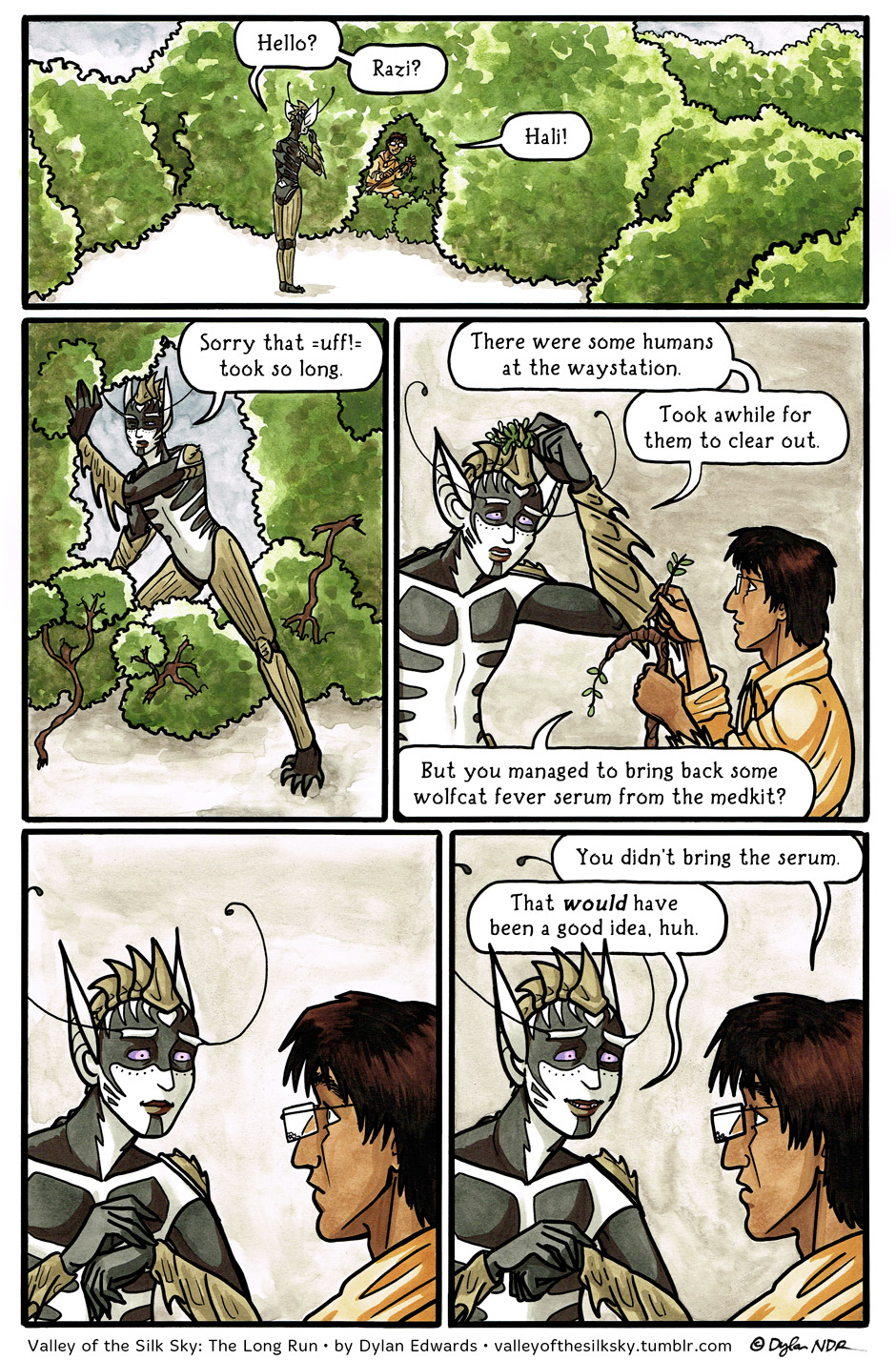
After the pencils are done I ink the pages. I can only ink about one page a day due to the aforementioned hand injury. Then the inks get scanned.
Finally, I color the inked pages, scan them, clean up the scans, superimpose the inks over the colored pages to get the black line art nice and crisp, letter everything, and prep for web. (Prepping pages for print is a different process, but I don't bother with it until I'm setting up print-ready files).
What’s the most difficult part of your work?
Writing is the most difficult part, drawing is the most labor-intensive part. Also, self-promo is my nemesis. I hate doing it, but it's necessary when you're an indie creator.
Can you tell me about your storytelling process? Do you prefer to script your stories, fly by the seat of your pants, or somewhere in between?
In general my stories are very tightly scripted, whether it's one page or a big project like Valley of the Silk Sky. I have other artistic outlets where I can be loose and free, but for storytelling I prefer to be very precise.
 How much of a buffer do you like to keep on your ongoing projects?
I post new Valley of the Silk Sky pages when I have an entire chapter completed.
If you could send a note back to yourself when you began working on your skillset, what would you say?
I got a late start making comics because I didn't believe my art was up to snuff, so I was waiting until I would magically become good enough at drawing before making any comics. But the only way to get good enough to make comics is by just sitting down and making some comics. And yeah, that early work will probably sear your eyeballs when you go back and look at it later, but if you don't ever get started you'll never hit that learning curve.
I've also learned to get less bogged down in perfectionism. Comics involves making hundreds of drawings just to tell a single story. Not every panel will be a work of genius. Just keep moving, keep looking for ways to improve.
Your work often deals frankly and cheerfully with very difficult, very personal topics. Our readers often bring up how difficult it is to find the courage to continue when dealing with difficult topics in their own work. How do you do it?
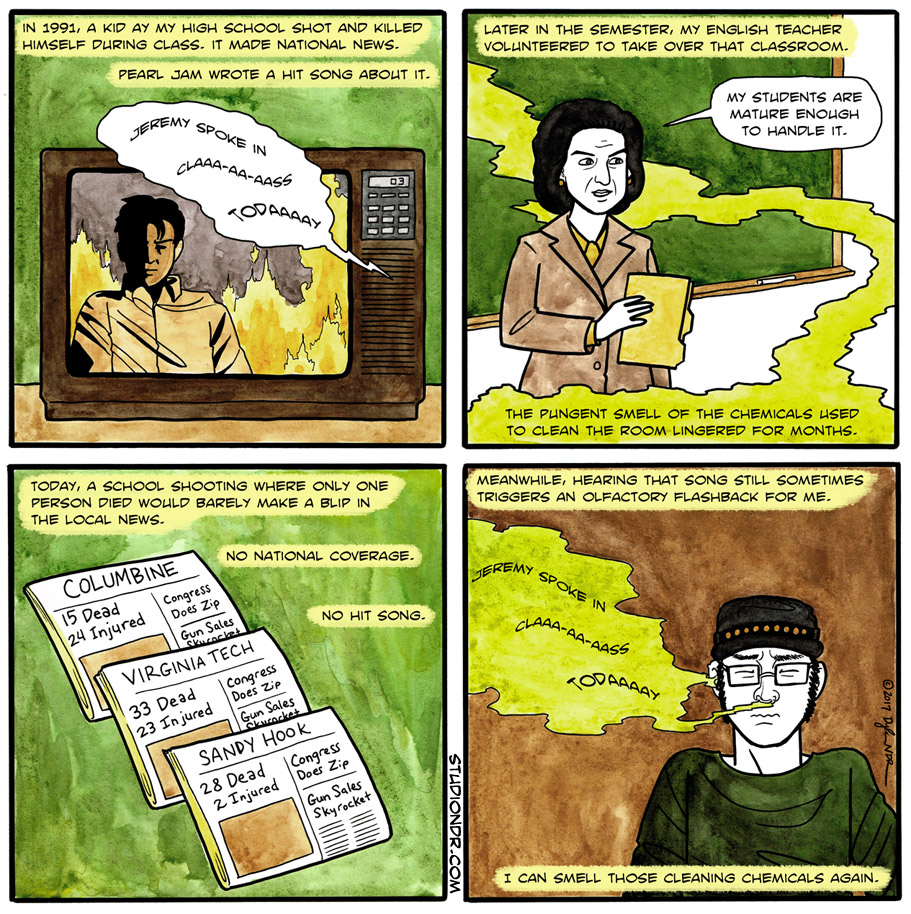
I have to be able to get some emotional distance from an issue to address it in a comic. That's not going to be possible for every subject. For instance, the gun violence comic I did for The Nib (
https://thenib.com/gun-response) I had originally intended to do as a longer piece. But just those four panels really took it out of me, and I was thoroughly relieved I hadn't committed to something bigger.
With queer or trans topics, those are just kind of running in the background of my life all the time and have been for a couple of decades, so I guess I'm just kind of used to talking about them. For sure, using humor as a framework helps me discuss the more difficult bits.
There are some topics I don't know that I'll ever put in a comic. At one point I thought about trying to do an autobio comic around my experiences with extremely severe depressive disorder, but I'm not sure I can, honestly. Even though the story has a happy ending more or less (meds absolutely worked for me), like the gun violence topic it's too much to immerse myself in it to the extent I'd need to to write a story.
 You’ve launched a pretty successful career as an indie comic artist and have great business sense. When you got started, where did you stumble? What advice would you give to others who’d like to follow in your footsteps?
Ha ha, well, I think "successful" is very relative and somewhat deceptive, and I'm not at all sure I have good business sense! I do okay with retail-like environments, like conventions, because I do have several years of experience working in entertainment retail. And I have several years of corporate graphic design experience, so things like signage or book covers I can do. But, like, I am thoroughly clueless about how to market myself online or really leverage social media. I'm just flinging things around hither and thither and hoping something clicks. Marketing is definitely one of my weak points.
As far as actual useful advice goes, two things:
1. Conventions are loud, crowded, and overstimulating. People are going to spend at most a couple of seconds glancing at your booth to decide if they want to step closer. To cut through that, your display needs to be as easy to scan as possible. Don't pack things too densely, and have some very pithy signage explaining what you've got (I have a sign that just says "QUEER COMICS" in giant sparkly letters). I'm pretty introverted and not good at sales patter, so I made little shelf talkers for each comic: just a short sentence describing each book.
2. Your book cover is an advertisement for your book. Put some effort into making it as sharp as you can. Go look at lots of professionally-designed book covers and pay attention to which ones draw you in. Then deconstruct them to figure out how all the elements are working together (title, author name, imagery). As much as people like to repeat the canard about not judging a book by its cover, the fact of the matter is, a bad cover can actually repulse potential readers. But a good cover pulls them in. As a bonus, you can use a good book cover for other advertising material like bookmarks or ads, so you don't have to create a whole separate slew of images.
What, to you, is the key ingredient to succeeding as an indie creator?
Part of it is stamina - you probably are not going to become an overnight sensation, so you need to be able to stick with it past the point where your friends and family are cheering you on (they'll get tired after about a year and aren't going to be coming out to every show you do).
Part of it is finding community, particularly if you're from a marginalized group. My experience with queer comics people is that they're very excited to have more folks making queer comics and have generally been very welcoming and supportive. A huge amount of my published work was the result of a recommendation rather than cold submissions.
If people would like to read more LGBT-focused works, which are your favorites?
First of all, let me recommend a wonderful tool set up by MariNaomi (whose comics you should be reading, by the way): The Queer Cartoonists Database. You can set up your own search criteria for browsing, and there are hundreds of listings to check out:
http://queercartoonists.com/
Some other recommendations:
Taneka Stotts, who works on several different comics and also assembles some of the best queer-focused anthologies I've read. Elements: Fire is excellent, as are both Beyond anthologies (and I'm not just saying that because I have a story in the first Beyond anthology, I promise).
Sfé Monster is a trans nonbinary creator who does a lot of wonderful work, including the genderqueer fantasy epic Eth's Skin. Sfé is also one of the editors for Beyond.
Der-Shing Helmer does a lot of stunningly gorgeous work.
Mare Internum is a great piece of sci-fi storytelling.
Mildred Louis is another phenomenal artist, who draws amazing facial expressions. Her comic Agents of the Realm is all about queer magical girls.
It's been fun to watch Melanie Gillman's career really take off. Their comic As The Crow Flies just received a very well-deserved Stonewall Book Award.
Kathleen Jacques does a comic called Band vs. Band which I enjoy quite a bit. A very fun lesbian rock & roll romp.
Blue Delliquanti's comic O Human Star is another great queer sci-fi work.
Ed Luce does a really fun comic about queer metalheads called Wuvable Oaf. It certainly helps if you're into metal and/or pro wrestling, but even if you're not his characters are engaging and unique.
If allies outside the LGBT community would like to support creators like you, what’s the best way for them to do it? What helped you when you got started?

Giving money to marginalized creators is one of the most important things you can do. Buy books, back Patreons, leave tips on Ko-Fi, snag some original art. The fact of the matter is, even someone who appears to be "successful" is probably still scraping by on a very modest income [coughs demonstratively]. There's this illusion that getting published means you're set, but it's much less true than you'd think. It's a long road from "I got a one-time payment of $500 for this one story" to "I'm able to support myself full-time from my art."
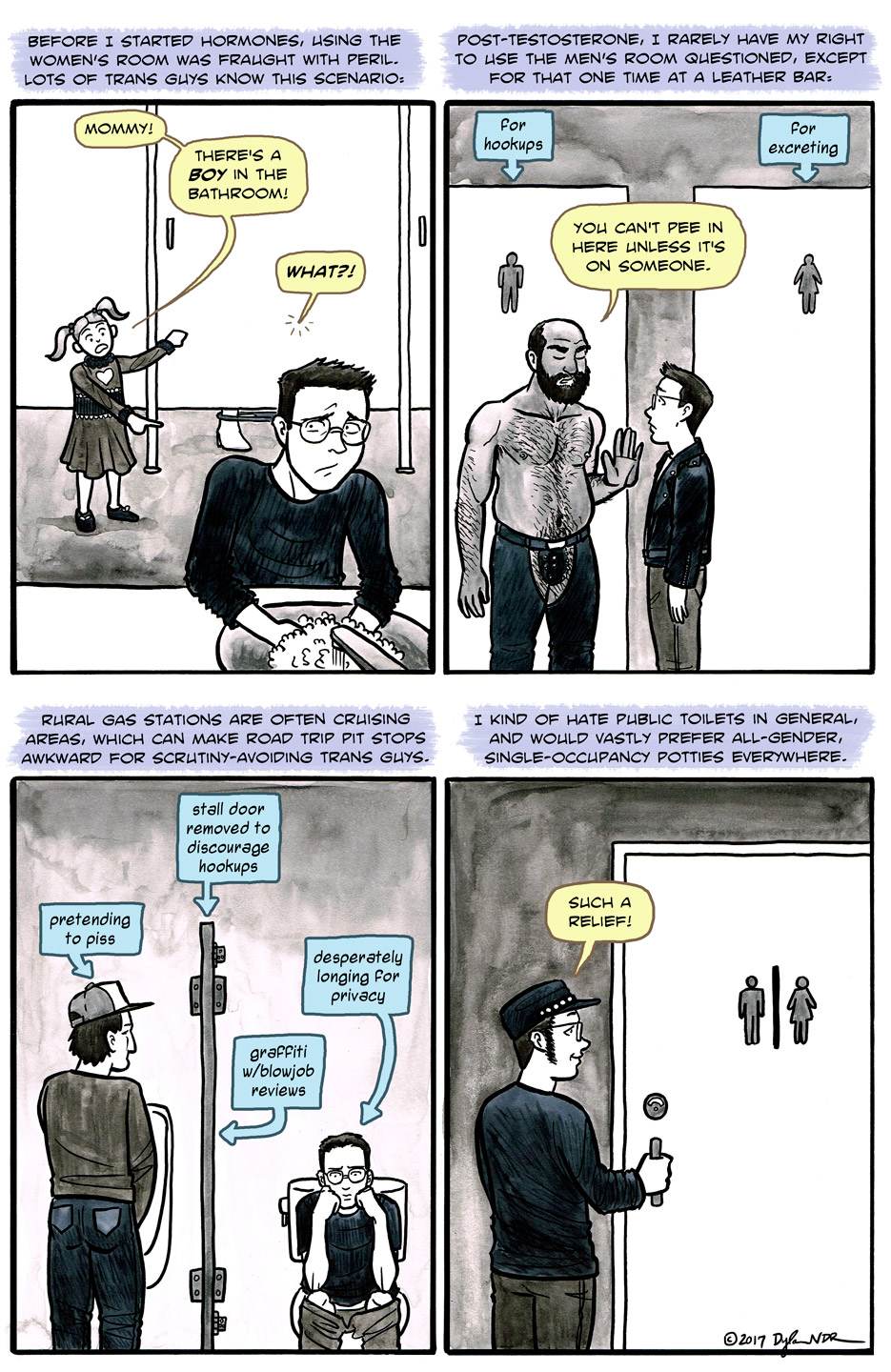
Folks who don't have a whole lot of cash to throw around can still help: write reviews on Amazon or Goodreads or wherever, tell your friends about this comic you really like, share links, etc. People who don't know me aren't going to pay that much attention if I'm blathering about my new book - it'll just get filtered out in all the noise. But if their best friend is saying "I really like this new book," they'll actually listen. We place a huge amount of stock in what our friends like.
What message do you hope readers take away from your work?
Broadly speaking, I like to write about figuring out who you are and how to make that work, and about finding your community. I'd say that holds whether I'm writing autobio comics or sci-fi adventures.
What keeps you devoted to telling the stories you’re telling?
My own personal interest in a topic. If it's a subject I care about, I can go on for quite awhile.
Thanks Dylan, looking forward to seeing more of your work!


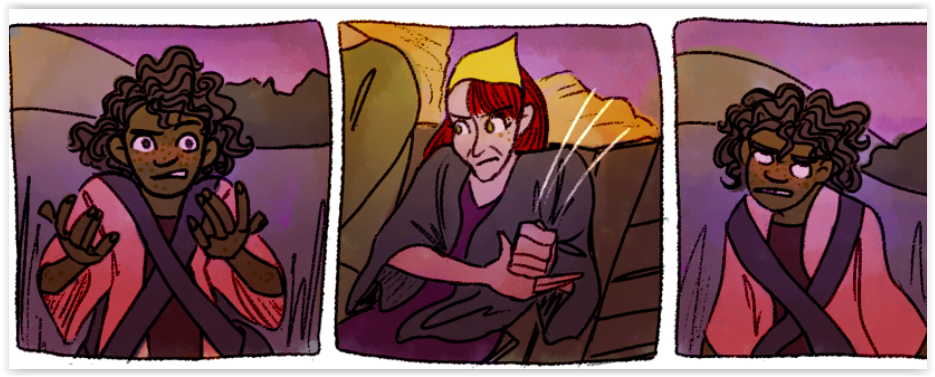
 In the classic style of ancient legends, the gods play games with the lives of mortals, rolling Fate as their dice. The story is written in such an experiential way that it never feels forced; in fact, you feel the helpless horror of the characters as they realize what they've gotten into. It's beautifully evocative and utterly heart wrenching. It's also a really powerful exploration of the amoral nature of narrative. With the right story, anyone becomes a monster. A beast. A demon. Or they become someone relatable and understandable. It's all in how the web of words is spun.
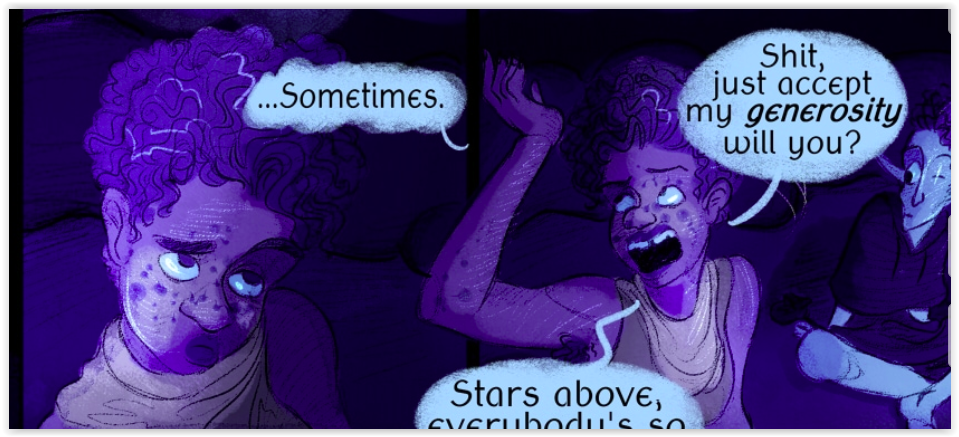 There's so much evocative power in this work that it could easily have been overwhelming. But it's leavened with moments of comfort, friendship, and joy up until the bitter end. (and yes, I mean that literally) The two main characters, Cethlenn and Balor, are so cleverly imagined at that tender teenage point where you almost know it all one day, and no nothing the next. It's an age when the world is so FRUSTRATING, because it just won't LISTEN to you!!! That feeling of fighting to find your own voice and being tired of the entire world's bull is beautifully captured. But so is the tenderness of new friendship, the terrifying and amazing feeling of becoming vulnerable to someone else, and the soft and electric thrill of budding romance.
 Yes, romance. Lesbian, interspecies YA romance. In an ancient setting. Ohhhhh yes. Perfectly rendered and absolutely wonderful.
 Speaking of that ancient setting: the art perfectly captures the Pictish and Old Celtic styles of an Ireland before it had iron. It's a powerful, visceral art style, saturated with mood-setting colors. Rough around the edges, it's designed to bypass the front of the brain and reach right down into the limbic system, pushing all the emotional buttons. And oh my, does it ever push.