Showing posts with label author interview. Show all posts

Saturday, July 18, 2020

Backstage Pass July: Paul Duffield

Come One, Come All! Slip Behind The Curtain And Meet

Paul Duffield


So Paul, tell us about yourself? 


I trained in illustration and animation at uni, and I’ve been a professional creative in a variety of fields for about 12 years! I’ve worked as a comics artist and writer, an illustrator and designer for books and magazines, a storyboard artist for film, and as an animator.


Main Projects:


My main project at the moment is The Firelight Isle, a tale of coming of age and cultural discovery in a civilization watched over by mysterious masked priests. The main characters are Anlil and Sen, who are childhood friends about to be parted as Sen takes the trail to join the priesthood, and Anlil weaves a sacred offering.
Patreon helps pay for it all. 


Other Hobbies, Guilty Pleasures and Obsessions

Many! I play a lot of video games and watch a lot of TV, including tons of anime. I play a variety of stringed instruments for fun, and also do a lot of board gaming (currently making my way through Gloomhaven with a friend). My most consuming hobby is probably LARPing, which I love designing and making outfits for, and writing music for when I can too.


So, tell us about your early experience. How did you fall in love with telling stories in pictures?


I’ve been obsessed with drawing from a very young age, but in terms of telling stories with pictures, it was really the beginning of online comics that did it for me. When I was in college I was introduced to the idea of producing your own comics and posting them online, so I started a webcomic, and hunted down a lot of comics by other amateur creators (there were no centralised webcomics sites back then). That really sparked my love for making comics.


What media and programs do you work in to produce your project?


Typically just Photoshop, although I also use InDesign for publishing books, and when I’m working on animation, I use Premier Pro and After Effects, too. I also sometime used 3D programs like Sketchup and 3DSMax to create reference models.


Can you tell me about your typical day or strip-creation session? How does your work process flow from idea to finished page?


If I took a snapshot of a single day of creation, it would normally just focus on one stage, like doing linework all day, or doing colouring all day, since I try to break the process into stages and do it in batches. On the production side of things I think I’ve managed to streamline my process quite well, and I work heavily with another amazing creator, Kate Brown, who can take on most of the process for me if time is tight.


On the ideas and writing side of things, it’s much messier! I use a hacked-together combo of written notes and scripts, along with thumbnails and sketches of various levels of detail. I’ve done a LOT of re-writing on The Firelight Isle, so there’s very little of the script that hasn’t been completely changed since I first started writing it.


You use a lot of religious overtones in your work. What attracts you to this theme?


I don’t follow a particular religion, but I find religion and the study of religion absolutely fascinating, and I’m always drawn to accounts of spiritual experience, possibly because I’ve never had any myself! Seeing the supernatural and sublime in the things around us seems to be a deeply rooted part of human nature, and I think it would actually be very hard to write about people without writing about religion in some way. Even if people aren’t explicitly religious, they often approach reality and community in religious ways.


You've used a lot of information about weaving and dyeing. I'd love to hear about how you do research for your project.


Research is one of my favourite parts of a project! Apart from a general interest in clothing and sewing, for The Firelight Isle, I watched a lot of instructional videos on weaving and dyeing textiles, along with visiting museums with exhibits about weaving, and looking into weaving techniques from a variety of cultures and times. I also got a couple of huge books which catalogue contume and clothing patterns from peoples around the work. It’s amazing how deep a subject it is! Despite looking into it for a long time, I think I mostly just discovered how much I could never know without hands-on experience.


What’s the most difficult part of your work?


I think the most difficult part is the totality. All the individual processes - the writing, the art, the design, the research and fun and challenging by themselves, but drawing them all together and making them into a working story is the hardest part. There’s always so much to consider in every panel, and my mind can only hold so many concepts and thoughts at a time.


Can you tell me about your storytelling process? Do you prefer to script your stories, fly by the seat of your pants, or somewhere in between?


A combination! I like to know where my stories are heading in a lot of detail, so I’ll plot them out beforehand, and in the case of The Firelight Isle, I’ve written a full script. But in terms of the pages themselves, I’ll often be changing layout and dialogue right before publication, and the parts of the script that I haven’t started drawing yet are constantly in a state of flux. It’s like taking a bunch of loose strings and knotting them together - the loose ends flop about and get tangled as I go, so I stop to untangle them from time to time.


How much of a buffer do you like to keep?


I’d love to keep a huge buffer, but I’m not able to do this full-time, so I don’t have any at all! Episodes take a LONG time, so my only choice is to post as I complete them, and even that’s not regular enough to build and maintain an audience reliably.


What’s a question you’d like to answer once and for all about your art and/or that question you’re sick of getting asked?


Haha! This is a great question. With The Firelight Isle, I guess the question I get asked most often was “is it inspired by Avatar: The Last Airbender?”, to which the answer is no. I watched Avatar for the first time last year and absolutely loved it, so the comparisons are flattering, but the story and visual style of The Firelight Isle is something I developed before I’d even heard of Avatar.


If you could send a note back to yourself when you began working on your skillset, what would you say?


Hmmm, tricky one! I think I’d encourage myself to try and find a mentor. Someone who had all the skills I wanted and could help guide me in learning. I had to do a lot of self-discovery as I went through education - my tutors were all very skilled, but none had that experience in stylized figure drawing, comics and naturalistic animation that I had to struggle to gain.


What message do you hope readers take away from your work?


I think that unless your work is highly instructional or didactic, hoping for your readers to extract a specific message is a somewhat doomed enterprise, and once your story is out there, you lose all control over how it’s interpreted.


So, in the absence of having explicit lessons or messages that the characters spell out, I try to work with concepts and themes that run throughout the story. The Firelight Isle is about a few things - searching for your identity, finding your place in your culture, where you draw the line between your duty to yourself and your community, and how you feel excitement or fear about the boundaries of your world.


I try not to reach specific conclusions about these things though, because they’re questions with so many answers that explaining them away reduces their power and complexity as elements of a story.


What keeps you devoted to telling the story you’re telling?


Some sort of madness I think... I’ve been doing this for nearly seven years now, and  unless something surprising happens, it will probably take another three to complete! Seriously though, there are a number of things driving me on. One is the simple desire to finish, to sit back and look at a completed thing and feel that sense of accomplishment. Another is sheer stubbornness and the sunk cost fallacy. Another is my belief in my original vision for the project, which if I’m honest has wavered a lot. My understanding of the themes and material I’m working with has changed drastically over seven years, but to a certain extent I’m stuck with the ideas and attitudes I had back then. Even so, at the heart of it, I think The Firelight Isle is a story worth telling, and I hope readers feel the same way. I also feel a deep sense of gratitude and commitment to the many people who have supported me along the way, not least my Patreon supporters who make it possible to continue.


Thanks for a great chat, Paul. And a hundred thanks for the wonderful work! 


Sunday, April 21, 2019

Backstage Pass April 2019: Suzana Harcum-White and Owen White of Tripping Over You


Today, Today Dear Readers, Backstage We Have For You
The Redoutable Suzana Harcum-White and Owen White!


Sometime ago I reviewed the lovely comic Tripping Over You, and today, I'll sit down with the creators to hear all about the work. Come on backstage!

Main Project:


Tripping Over You (www.trippingoveryou.com), The Death of Caleb Perkins (www.deathofcaleb.com)

Other Hobbies, Guilty Pleasures and Obsessions:

Video games, music, coding, drawing and writing outside of comics, cooking

So, tell me about your early experience. How did you fall in love with telling stories in pictures?

Suzana and I had feelings for each other a long time before we starting making the comic; we made countless characters who also had feelings for each other, and I feel like we were always hoping that the other person would take the hint about it! Milo and Liam were some of those characters we made for each other— I would draw her character, and she would draw mine, we'd send writing snippets back and forth, and we fell in love with the chance to gift each other little things from the heart that way. When we did eventually start dating and moved in together, we realized how much we missed that aspect of our relationship— we wanted to find a new hobby that we could enjoy together that also gave our characters a place to continue existing, that we could write and draw for each other through. Comics ended up being what we dove into full-time and eventually became something we could (very, very fortunately) build a career out of, but we really love the process in quite a few mediums.

What media and programs do you work in to produce your project?

We've switched full-time to Clip Studio Paint for our current chapter, and so far it's been an absolute pleasure to work with. Huge, huge relief— infinitely easier to create in. Prior to that we were using SAI and Photoshop, which we enjoyed until Clip blew everything out of the water.

Can you tell me about your typical day or strip-creation session? How does your work process flow from idea to finished page?

Ideas usually start with Suzana and I talking about things we'd love to include in the comic - sometimes out loud in conversation, sometimes as sketches in our sketchbooks. The overall plot points have already been mapped out in outline, but we'll occasionally discuss minor jokes or secondary plot ideas as we go. I'll sit down and write the entirety of a chapter at once, over the course of several days— first in script, then in thumbnails. I bring the thumbnails to Suzana, and she drafts sketched pages from the thumbnails - shifting things as necessary, re-ordering scenes, changing the visualization, etc. I then put word bubbles on so she knows where her art needs to move to for readability, and she then inks the sketch. I flat and do some shading, Suzana puts finishing touches on, and that's a typical day for us. Each page takes anywhere from 6-12 hours depending on a lot of factors.


What’s the most difficult part of your work?

It's very time consuming to finish, and takes up most of our free-time. Each page takes a long time, and each chapter then takes exponentially longer, so the story never quite moves as quickly as we'd like! The frustration of always wishing we could work faster/have infinite more time to work with is I'd say the most difficult part for us.


Can you tell me about your storytelling process? Do you prefer to script your stories, fly by the seat of your pants, or somewhere in between?

We prefer to script. Sometimes we'll improv-slide a joke or two in here or there, but planning stuff out is the most fun part of the process, so we do a lot of it just for fun! (You can always plan so much faster than you can make!)


How much of a buffer do you like to keep?

We like to keep way more of a buffer than we actually do lmao. If we don't have a buffer we stream the page live the day before it goes up, though, which is also really fun.


What’s a question you’d like to answer once and for all about your art and/or that question you’re sick of getting asked?

I have no idea! We don't mind questions at all, even repeat questions we just understand come from that person never having seen us answer it before. The internet is so cool for how easily you can find stuff on it, but it's also true that there's SO much stuff on it that it's just impossible for anyone to have read everything you've ever said or that someone has said about you, so I don't think there'll ever be a "once and for all" when you really enjoy interacting with others online— and we're totally cool with that! It's fun!


If you could send a note back to yourself when you began working on your skillset, what would you say?

Look into Clip Studio literally the second it's made, don't put off switching to it. Also don't lift anything heavy over your tablet.


I know it's the dread question, but how many of the issues you explore on family dynamics and acceptance were drawn from personal experience and/or what you watched friends go through? Any of it?

Oh, nearly all of it. Most of it is exaggerated for comedy, and very occasionally it's stuff that friends of ours have gone through, but for sure like 95% of it is anecdotal. None of the characters are meant to be a 1:1 for us, though, or for our family members, but it's pretty impossible to leave yourself entirely out of anything you make, and there are very many snippets of things that have been said to us (or at us) embedded in this particular story.


What message do you hope readers take away from your work?

Sometimes you're just gonna suck at something, whether it's a career, a hobby, or even just expressing yourself clearly to someone you love. It's okay, as long as it's not the end of you trying.


What keeps you devoted to telling the story you’re telling?

Pure, unadulterated self-indulgence. ♥ We are addicts.


Thanks ladies, and keep up the gorgeous work!


Saturday, April 14, 2018

Backstage Pass April: Dylan Edwards

Here's Your Pass!

Let's Slip Backstage And Meet


So Dylan, tell us a little about yourself!

Born in Colorado, grew up in Texas, moved to the UK, moved to Boston, moved back to Texas, and now back in Colorado. I think this means I have to move back to the UK next.

Main Projects: 

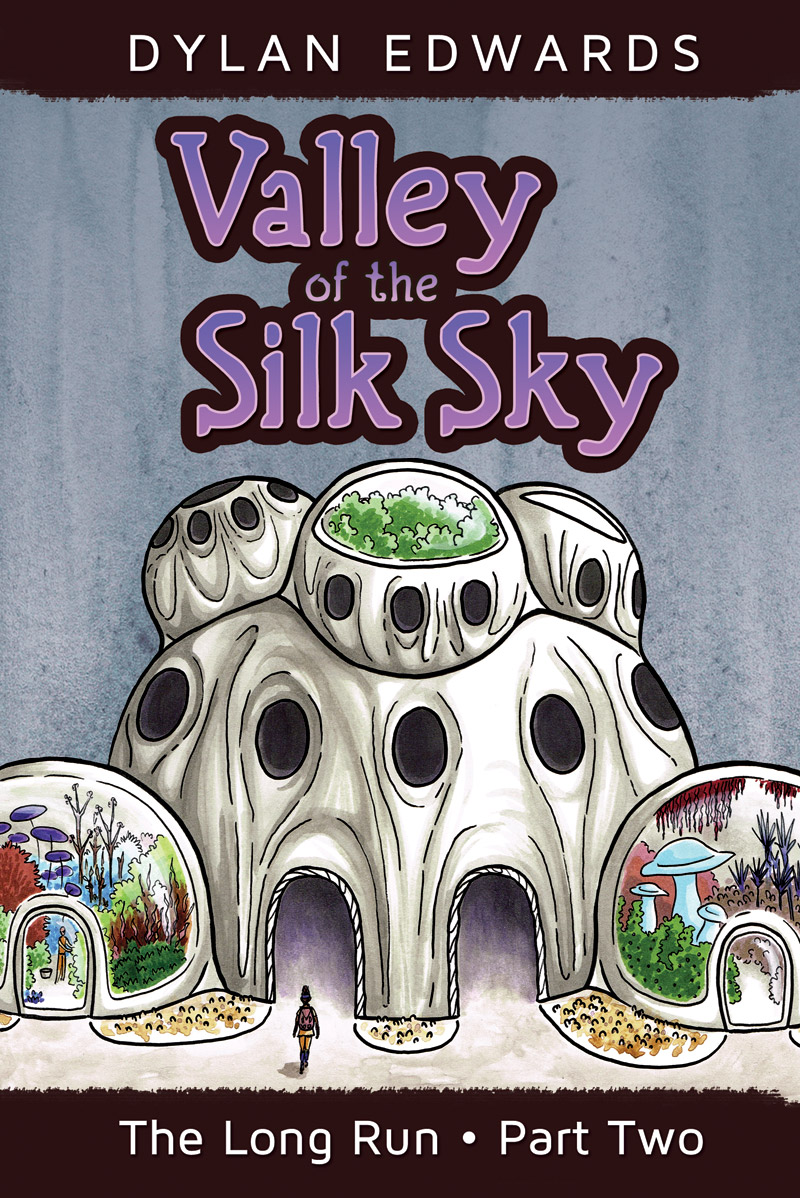
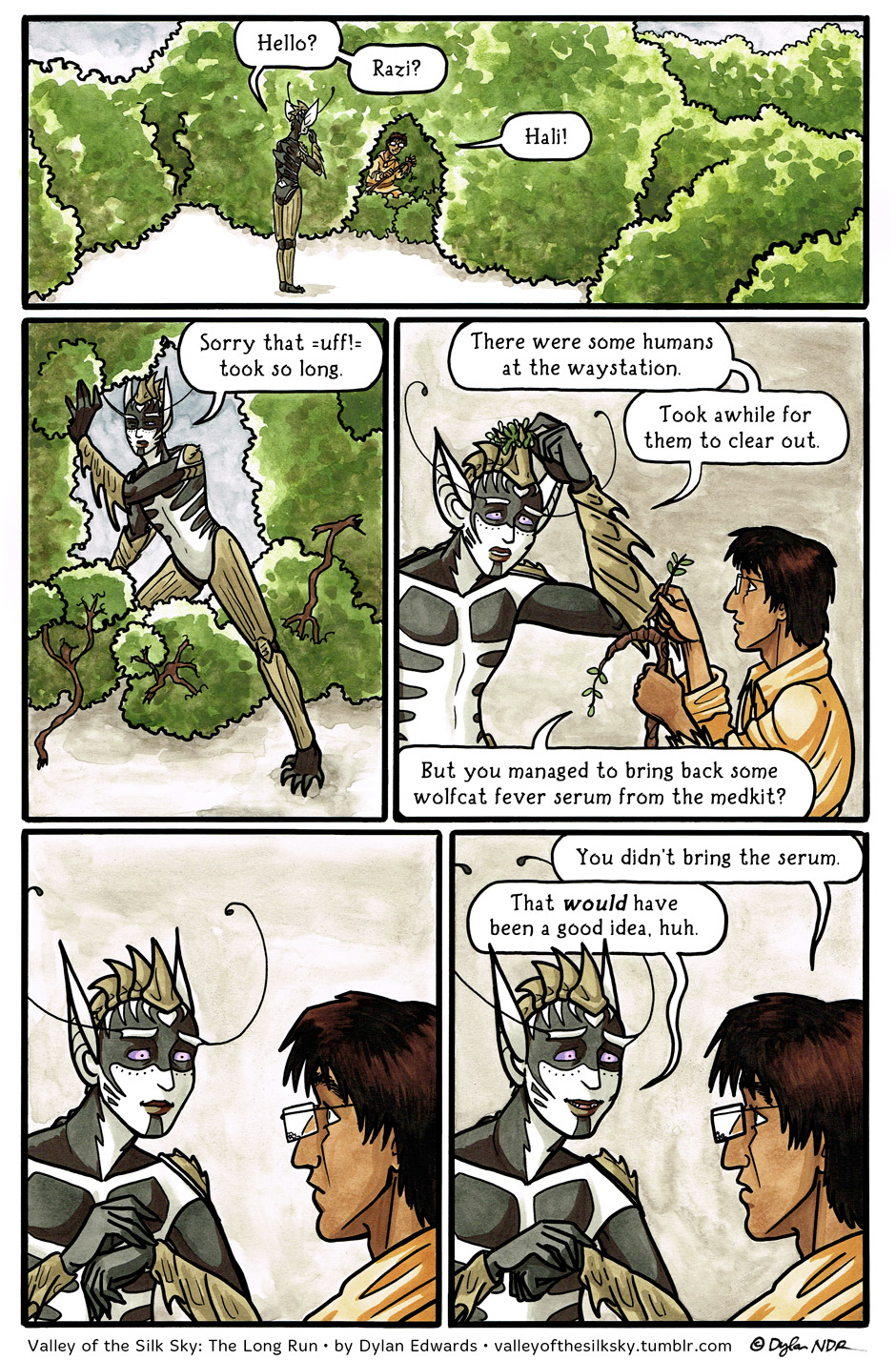
Valley of the Silk Sky is my current main project, a graphic novel I'm serializing as a weekly-ish webcomic.

http://valleyofthesilksky.tumblr.com/
I've always been a fan of genre fiction and had wanted to create my own since forever. It's my excuse to draw lots of weird creatures and environments, and to include queer and trans characters in a sci-fi/fantasy story. Everything else is up at http://www.studiondr.com/ and fun stuff is up at http://www.feepingcreatures.com/


 Other Hobbies, Guilty Pleasures and Obsessions

I enjoy reading, and playing games of all sorts (board, video, role-playing).

So, tell me about your early experience. How did you fall in love with telling stories in pictures?

I didn't read comic books much as a kid (I had a few, but didn't collect them as an ongoing thing). My comics diet consisted mostly of collections of newspaper strips like Pogo, Peanuts, Calvin & Hobbes, and Bloom County.
Around age 8 or 9 I decided I was going to do a daily newspaper comic, so I cranked out a bunch of three-panel strips that were just pencil on plain paper, at what would have been print size. Most of the jokes were stolen directly from Snoopy-centric Peanuts, except Snoopy was replaced by a talking horse named Donder.
When I was 10 or so I tried to do an actual comic book, this time about Paul McCartney as a private investigator (not really sure where that idea came from). I made it two pages in before I realized how much work was involved and abandoned it for other pursuits.
So the impetus was always there. I can't really say it was a conscious choice, just something I was naturally drawn to.

What media and programs do you work in to produce your work?

I do most of the work in natural media: pencil on bristol board, inked with Pigma Sensei and Copic pens, colored with Copic marker and gouache.
These days I do the lettering digitally in either Photoshop or InDesign, depending on what the project calls for. I know a lot of people are cranky about digital lettering, but I unfortunately have a permanent injury to my drawing hand that makes hand-lettering painful and debilitating. Also, let's be real, my hand-lettering is borderline illegible and requires an enormous amount of digital cleanup. So I *could* spend 75% of my comic-making hours on my absolute least favorite part of the process, or I can letter digitally and spend most of my time actually drawing.

 Can you tell me about your typical day or strip-creation session? How does your work process flow from idea to finished page?

What I do on any given day depends on where I am in my creation cycle.
I generally start by typing out a script. Scripts for personal use generally just have dialogue and very minimal stage directions. Scripts for editors have image descriptions in addition to the dialogue, and are broken out into panels and pages.
I revise the script until it hits a point where I feel like it's ready to thumbnail. I do my thumbnailing digitally at full-size so I can make sure the dialogue or other text actually fits on the page. I also typically cut a huge chunk of text at this point, once it becomes more clear how much of the heavy lifting will be done by the art.
I like to let the thumbnails sit for a few days so I can come back to them with fresh eyes and do more revisions. If I feel like they're scanning well, I'll move to pencils. It's not unusual for me to revise thumbnails while I'm penciling, like if some detail I drew on page one might change what I need to do on page five.
For Valley of the Silk Sky, where I work on a chapter at a time, I pencil the whole chapter first in case I need to go back and revise something, again based on details that show up in the art. Pencils are also mostly last call for dialogue revisions (I may still revise the text further down the road, but it gets to be a pain in the ass once I move on to indelible media). I keep scans of all the pencils for reference.
After the pencils are done I ink the pages. I can only ink about one page a day due to the aforementioned hand injury. Then the inks get scanned.
Finally, I color the inked pages, scan them, clean up the scans, superimpose the inks over the colored pages to get the black line art nice and crisp, letter everything, and prep for web. (Prepping pages for print is a different process, but I don't bother with it until I'm setting up print-ready files).

 What’s the most difficult part of your work?

Writing is the most difficult part, drawing is the most labor-intensive part. Also, self-promo is my nemesis. I hate doing it, but it's necessary when you're an indie creator.

Can you tell me about your storytelling process? Do you prefer to script your stories, fly by the seat of your pants, or somewhere in between?

In general my stories are very tightly scripted, whether it's one page or a big project like Valley of the Silk Sky. I have other artistic outlets where I can be loose and free, but for storytelling I prefer to be very precise.

How much of a buffer do you like to keep on your ongoing projects?

I post new Valley of the Silk Sky pages when I have an entire chapter completed.

If you could send a note back to yourself when you began working on your skillset, what would you say?

I got a late start making comics because I didn't believe my art was up to snuff, so I was waiting until I would magically become good enough at drawing before making any comics. But the only way to get good enough to make comics is by just sitting down and making some comics. And yeah, that early work will probably sear your eyeballs when you go back and look at it later, but if you don't ever get started you'll never hit that learning curve.

I've also learned to get less bogged down in perfectionism. Comics involves making hundreds of drawings just to tell a single story. Not every panel will be a work of genius. Just keep moving, keep looking for ways to improve.

 Your work often deals frankly and cheerfully with very difficult, very personal topics. Our readers often bring up how difficult it is to find the courage to continue when dealing with difficult topics in their own work. How do you do it?

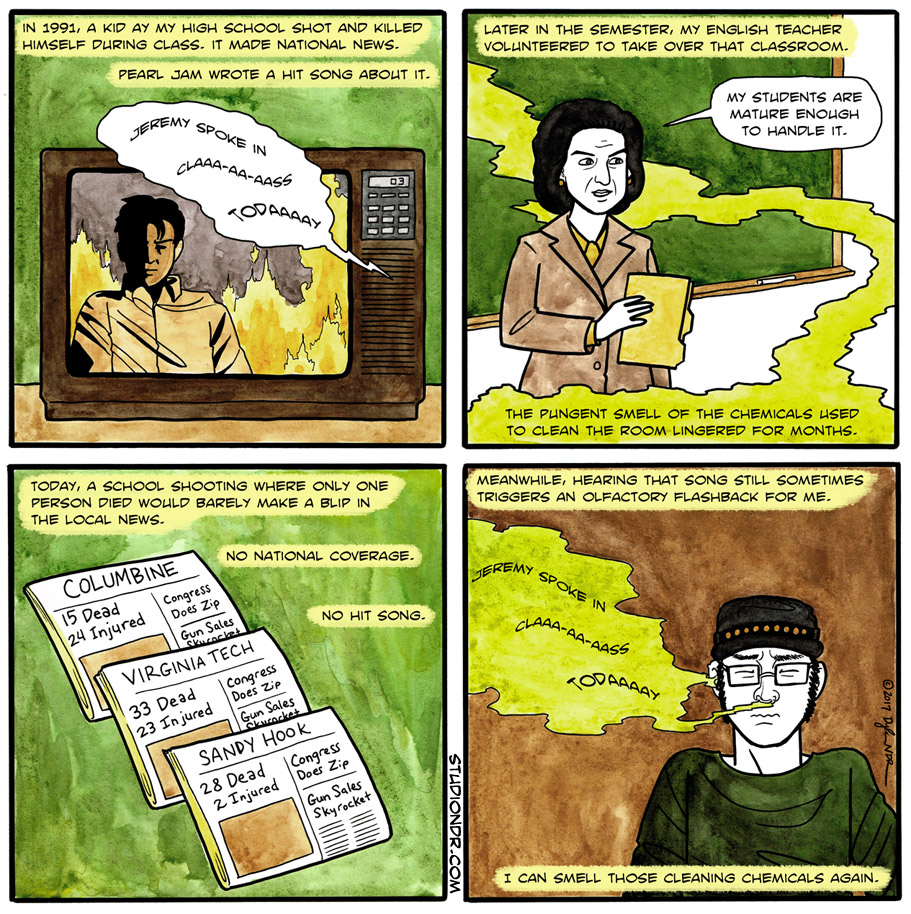
I have to be able to get some emotional distance from an issue to address it in a comic. That's not going to be possible for every subject. For instance, the gun violence comic I did for The Nib (https://thenib.com/gun-response) I had originally intended to do as a longer piece. But just those four panels really took it out of me, and I was thoroughly relieved I hadn't committed to something bigger.
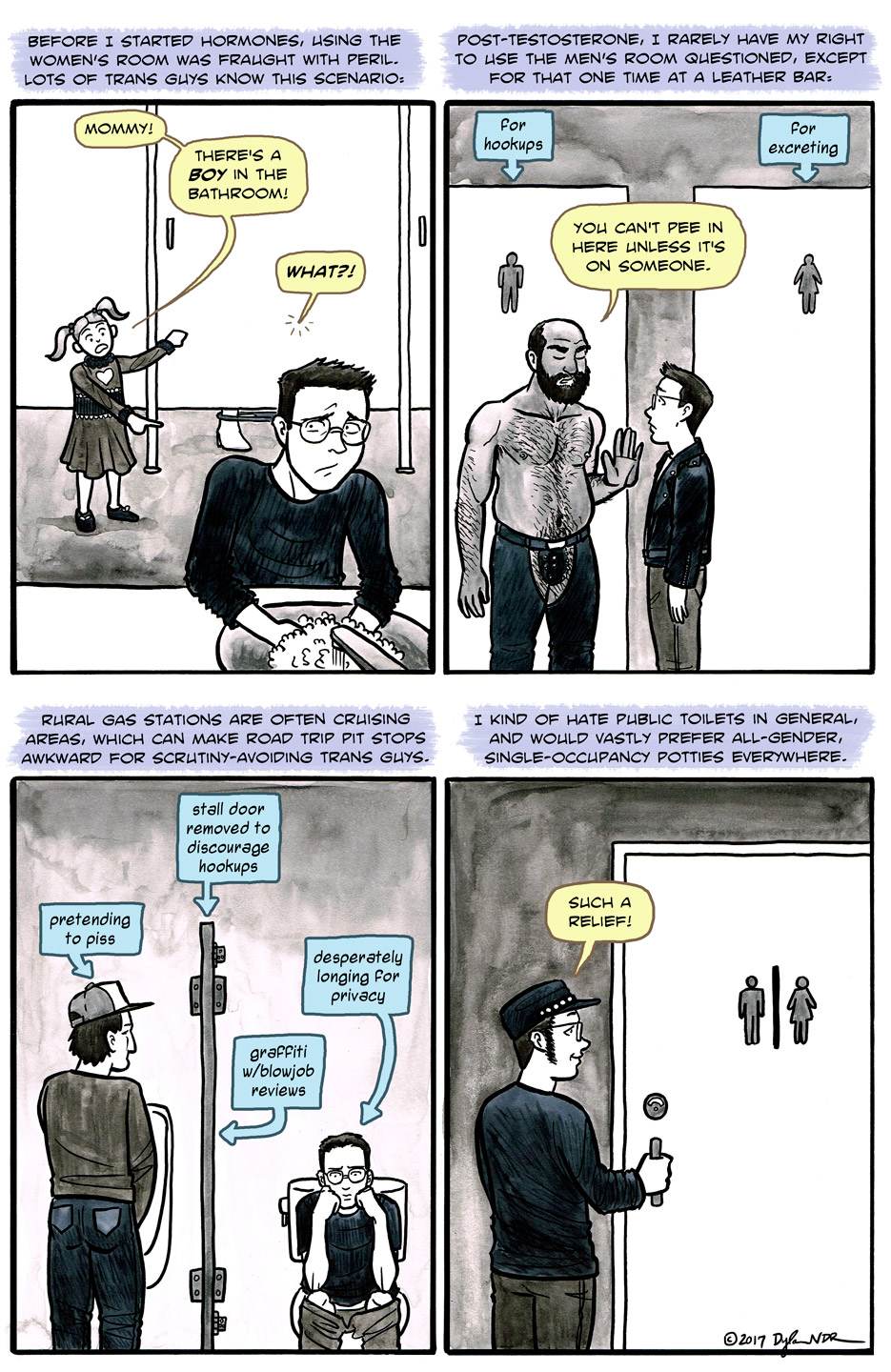
With queer or trans topics, those are just kind of running in the background of my life all the time and have been for a couple of decades, so I guess I'm just kind of used to talking about them. For sure, using humor as a framework helps me discuss the more difficult bits.
There are some topics I don't know that I'll ever put in a comic. At one point I thought about trying to do an autobio comic around my experiences with extremely severe depressive disorder, but I'm not sure I can, honestly. Even though the story has a happy ending more or less (meds absolutely worked for me), like the gun violence topic it's too much to immerse myself in it to the extent I'd need to to write a story.

You’ve launched a pretty successful career as an indie comic artist and have great business sense. When you got started, where did you stumble? What advice would you give to others who’d like to follow in your footsteps?


Ha ha, well, I think "successful" is very relative and somewhat deceptive, and I'm not at all sure I have good business sense! I do okay with retail-like environments, like conventions, because I do have several years of experience working in entertainment retail. And I have several years of corporate graphic design experience, so things like signage or book covers I can do. But, like, I am thoroughly clueless about how to market myself online or really leverage social media. I'm just flinging things around hither and thither and hoping something clicks. Marketing is definitely one of my weak points.

As far as actual useful advice goes, two things:
1. Conventions are loud, crowded, and overstimulating. People are going to spend at most a couple of seconds glancing at your booth to decide if they want to step closer. To cut through that, your display needs to be as easy to scan as possible. Don't pack things too densely, and have some very pithy signage explaining what you've got (I have a sign that just says "QUEER COMICS" in giant sparkly letters). I'm pretty introverted and not good at sales patter, so I made little shelf talkers for each comic: just a short sentence describing each book.
2. Your book cover is an advertisement for your book. Put some effort into making it as sharp as you can. Go look at lots of professionally-designed book covers and pay attention to which ones draw you in. Then deconstruct them to figure out how all the elements are working together (title, author name, imagery). As much as people like to repeat the canard about not judging a book by its cover, the fact of the matter is, a bad cover can actually repulse potential readers. But a good cover pulls them in. As a bonus, you can use a good book cover for other advertising material like bookmarks or ads, so you don't have to create a whole separate slew of images.

What, to you, is the key ingredient to succeeding as an indie creator?

Part of it is stamina - you probably are not going to become an overnight sensation, so you need to be able to stick with it past the point where your friends and family are cheering you on (they'll get tired after about a year and aren't going to be coming out to every show you do).
Part of it is finding community, particularly if you're from a marginalized group. My experience with queer comics people is that they're very excited to have more folks making queer comics and have generally been very welcoming and supportive. A huge amount of my published work was the result of a recommendation rather than cold submissions.

 If people would like to read more LGBT-focused works, which are your favorites?

First of all, let me recommend a wonderful tool set up by MariNaomi (whose comics you should be reading, by the way): The Queer Cartoonists Database. You can set up your own search criteria for browsing, and there are hundreds of listings to check out:
http://queercartoonists.com/

Some other recommendations:
Taneka Stotts, who works on several different comics and also assembles some of the best queer-focused anthologies I've read. Elements: Fire is excellent, as are both Beyond anthologies (and I'm not just saying that because I have a story in the first Beyond anthology, I promise).
Sfé Monster is a trans nonbinary creator who does a lot of wonderful work, including the genderqueer fantasy epic Eth's Skin. Sfé is also one of the editors for Beyond.
Der-Shing Helmer does a lot of stunningly gorgeous work. Mare Internum is a great piece of sci-fi storytelling.
Mildred Louis is another phenomenal artist, who draws amazing facial expressions. Her comic Agents of the Realm is all about queer magical girls.
It's been fun to watch Melanie Gillman's career really take off. Their comic As The Crow Flies just received a very well-deserved Stonewall Book Award.
Kathleen Jacques does a comic called Band vs. Band which I enjoy quite a bit. A very fun lesbian rock & roll romp.
Blue Delliquanti's comic O Human Star is another great queer sci-fi work.
Ed Luce does a really fun comic about queer metalheads called Wuvable Oaf. It certainly helps if you're into metal and/or pro wrestling, but even if you're not his characters are engaging and unique.

 If allies outside the LGBT community would like to support creators like you, what’s the best way for them to do it? What helped you when you got started?

Giving money to marginalized creators is one of the most important things you can do. Buy books, back Patreons, leave tips on Ko-Fi, snag some original art. The fact of the matter is, even someone who appears to be "successful" is probably still scraping by on a very modest income [coughs demonstratively]. There's this illusion that getting published means you're set, but it's much less true than you'd think. It's a long road from "I got a one-time payment of $500 for this one story" to "I'm able to support myself full-time from my art."
Folks who don't have a whole lot of cash to throw around can still help: write reviews on Amazon or Goodreads or wherever, tell your friends about this comic you really like, share links, etc. People who don't know me aren't going to pay that much attention if I'm blathering about my new book - it'll just get filtered out in all the noise. But if their best friend is saying "I really like this new book," they'll actually listen. We place a huge amount of stock in what our friends like.


What message do you hope readers take away from your work?

Broadly speaking, I like to write about figuring out who you are and how to make that work, and about finding your community. I'd say that holds whether I'm writing autobio comics or sci-fi adventures.

 What keeps you devoted to telling the stories you’re telling?

My own personal interest in a topic. If it's a subject I care about, I can go on for quite awhile.


Thanks Dylan, looking forward to seeing more of your work!