Friday, January 13, 2017

Backstage Pass January:Tantz Aerine

Psst! Slip Behind The Curtain! Here's Your Backstage Pass!

And Just Look Who's In The Dressing Room! It's Tantz Aerine!

In a time when the world seems a little dark and quite a few people are throwing around the terms 'Hitler' and 'Nazi', here's a creator brave enough to tell the true stories of Nazis, Resistance Fighters, and what it really cost to fight for the soul of your country.

Tantz, will you introduce yourself?


I’m Tantz Aerine (IRL Tanya Geritsidou), a Greek psychopedagogue born in Quebec, Canada. I specialize in educational policy and have a background in psychology and a long experience in teaching methods. My science aside, I’m also a professional author, mostly of high fantasy. I’m most known for my high fantasy trilogy The Art of Veiling,
but I also write short stories and scripts. The past near decade I also am very seriously invested in creating webcomics, mostly graphic novels.

Main Projects 

My main webcomic project is Without Moonlight, which is definitely one for the long road.
WM is basically a tour of the visceral underbelly of Greece’s modern history starting with the occupation by the Nazis (and their Italian and Bulgarian allies) during WWII, and, if I am able and live long enough, reaching up to the 1980s, in successive volumes-units as the story advances and characters come and go. All of it I plan to explore through Fotis, who is one of the main characters.  It’s his life we follow, hopefully until he becomes an old man. I say hopefully, because sometimes the story surprises even me, and Fotis might give the torch to someone else to carry on to the 80s, through all the torrential, extremely dangerous circumstances of Greek modern history.

Other Hobbies, Guilty Pleasures and Obsessions


I love baking cakes, coffee cakes… basically any kind of dessert.
My guilty pleasure has to be binge watching series.
I’m not sure about obsessions actually… unless… well, I want to keep my activism out of this interview, but you could say I’m obsessed with having International Law and Human Rights actually applied to everyone without exception. A simple adherence to these laws would solve immediately an astounding amount of problems. It just wouldn’t help the minority we all know make money as it does anymore.

So, tell me about your early experience. How did you fall in love with telling stories in pictures?

I always loved to draw and expand my drawing skills. I’m self taught, so that entailed me basically doodling everything and at all times. When I was in high school I had a large notebook where I wrote my stories, and a lot of loose papers where I doodled my characters and other things I found interesting.
I used my cartoons and general love of sketching in my classes as a teacher, in various ways to keep the children engaged and motivated. That led to me making short comics of my students as characters in stories that they built over the week, serving as their reward for their hard work.
And well, one thing led to another…

What media and programs do you work in to produce your project?

Up until recently, I used Photoshop. But then the program got corrupted and wouldn’t run in Windows 10, so I was obliged to transfer to GIMP.
I work 100% digitally: GIMP + Intuos tablet.


Can you tell me about your typical day or strip-creation session? How does your work process flow from idea to finished page?

The plot for WM is already sketched out and complete for the entire project, as I said barring any unexpected twists or turns the characters might throw my way.
I have the script for the next few scenes already penned down (so that’s about 2-3 months’ worth of updates, assuming I update once per week).
When I feel ready to sit down and make a page, I re-read the scene I’m currently making to get in the mindset and the mood I’m going for. Then I make the layout of the page, by matching lines to panels: that way I know how much of the script is going on the page, and how I’ll illustrate it (i.e. how many panels, angles, etc).
Then I work linearly, going at the first panel of the page and finishing it completely (i.e. colour and lighting) before I go to the next one. So by the time I’m finished with the final panel of the page, the page is also finished and ready for lettering.
The entire process usually takes about 8 hours. I like to be able to make a page in one sitting but usually with my obligations I work in 4 hour sessions over two days.

What’s the most difficult part of your work?

A big part of my comic is dialogue- characters talk and argue and fight. The action is intense but in short bursts, just like in real life. Things happen very fast and with absolute effects, but they don’t happen all the time. In between, characters run around and ruminate to be able to set up the circumstances so that they will win next time, in the next action burst.
So the hardest part of my work is to avoid talking head syndrome. I want the talking to be just as intense as the action and engage the reader, and that has to happen through body language and the nuances to be discovered as the characters talk.
Can you tell me about your storytelling process? Do you prefer to script your stories, fly by the seat of your pants, or somewhere in between?

I prefer to have my script ready by the time I put pen to tablet, and that’s because my story is basically a historical graphic novel. I can’t afford to fly by the seat of my pants, because I have to be certain everything is as accurate as possible in terms of the story fitting the history.
I had made a comic, Wolf, 100% flying by the seat of my pants, and it was super fun! It also helped me learn how to make webcomics and for that I’ll always have affection for it, even though it’s ghastly art wise.
But Wolf was a bio-science thriller story in a fictional contemporary city, and I felt I had free hand to do what I wanted without anyone fact checking on it. WM on the other hand, isn’t nearly as forgiving.

 I have to make everything just right, fit it just right so the story would plausibly be one that could have happened in 1942 Athens, time it just right to hit the dates I have to hit, so I feel I have to have good control of the story. Hence, script is necessary

How much of a buffer do you like to keep?

Ah… I would like to keep 2 weeks’ worth of buffer (i.e. about 3-4 pages). I have never managed it. I work with no buffer, and my readers understand that I make a page as quickly as I can, and upload it immediately.


Has anyone told you that you'll never be a successful artist and you'd be better off studying a real field and/or getting a real job?

No, but that is probably because by the time I started making comics and being an artist (including my author side) I already also had my degree and worked a ‘real job’. So I did used to get a bit of shade or side looks, but nobody felt they had the right to tell me anything. I think though that the times are different than the 90s and the 00s. Especially since ‘real jobs’ don’t pay as much lately either, what with the global recession craze, and a successful freelance artist might be in a position to make the minimum wage at least.


What message do you hope readers take away from your work?

“There’s so much more to history than what I’m taught in school, and it might give me new insights about the world!”
“There’s more to Greece than her ancient history and her contributions to the world continued beyond Alexander the Great.”
“War isn’t just the battle theaters of the fronts, but also the occupations, the devastations, the silent annihilations that don’t make the news.”
“Fascism rhetoric is uncannily current and way too modern to feel at ease that it is dead. There was a time where the swastika was just another flag among the rest.”

So much of your story is historical in nature: how do you go about researching it? What's the research to art-making  ratio in your work?

I prefer direct sources to secondary ones. Those aren’t very easy to find if you don’t know where to look.
Greek boys who were part of the Athens Resistance

For that reason, I did most of my research (and bibliography compilation) before I even started creating the plot, let alone the script or any page.
Accounts of what took place in Greece during WWII (and especially during the occupation which is when WM begins) are abundant but relatively superficial if you try to research the daily life of the people in the cities and in the country, the smaller events that took place, etc. History, when packaged for international audiences, tends to record only big hallmarks, such as the first ever sabotage in Europe that took place by the newly formed resistance in Greece, but neglects to document the daily smaller events of resistance, such as demonstrations of unarmed people against fully armed Nazis, the food-supplement network to battle famine, and a lot of other things.
So what I did was go right for the direct accounts and records of the events as recent to them as possible. I began with state archives of the impact of the occupation in Greece, compiled by the ministry responsible in 1947. Then I researched all the documentation printed and issued by resistance movements of the time. I have books and newspapers that used to be illegal at the time (on pain of death) documenting stuff about daily living and other issues that I wouldn’t otherwise know.
I also have big collections of photographic evidence of the era, ranging from photos of atrocities to photos of daily living (e.g. a picket of Nazis at a tavern having lunch, with some other Athenians sitting around in other tables numbly, and so on).

An Athenian being harassed for the amusement of Nazi soldiers
I also have collections of propaganda and anti-propaganda, newspaper clippings and front pages, posters, you name it.
I keep researching though, and every new source or document that falls in my hands, I collect and keep. Sometimes I even adjust my story’s plot to incorporate it, or just make sure to illustrate it in the background.
Methods of research to amass all of that include of course intense internet research but also a lot of diving in old bookstores that specialize in old authentic books and newspapers (there are a lot of those here in Athens), attending events presenting such evidence, interviewing survivors (some are still alive today), going out at the actual places where WM takes place and taking photos (the city center hasn’t changed since 1930), and then looking for the changes in the areas of Athens that HAVE changed, so that I may depict Athens during the 40s as faithfully as possible.
How do you go about doing your research? What are some of your favorite sources?
Favourite sources (newspapers and clippings aside) include:
(in Greek)
    A Greek soldier holding his daughter

  • The Greek Resistance, as revealed by the secret archives of Wehrmacht in Greece by P.K. Enepekides (1964) (also available in German)
  • Greece under the Swastika, documents from the German archives, edited by Martin Seckendorf (also available in German) (1991)
  • Testimonials Regarding the Greek Resistance, by D. Gyftopoulos (1984)
  • Light in the Darkness of the Occupation, National Resistance 1941-1944, Heroism & Sacrifice, Decadence & Treasons, by N. Antonakeas (1947)
  • White Bible, May 1944 to March 1945, by E.A.M. (National Liberating Front) (1945)
  • Photos of the Occupation, photo evidence from the German archives about the heroic resistance of the Greek people, by V. Mathiopoulos (1980)
  • (in English)
  • Hitler, a biography, by V. Ulrich, (2013)
  • Report of the FAO Mission for Greece, by Food and Agriculture Organization of the United Nations (1947)


Partisan fighters lauded in their home town in the mountains
One thing I really want to mention is that the older the sources, the more emotionally charged they are, and the more politically skewed they are. I have sources written by royalists, by communists and by democrats, all giving accounts of the same events. All of them try to support their take on those events by documents and other evidence. It is fascinating to see not only what happened at the time, but how much and how viciously political parties vied for power over the interests of the Greeks or Greece herself- and just as heartbreaking and touching to see that all the people in all those groups were shedding their blood for the very same cause, unaware of the political machinations of the few in every political party’s top tier.
I strive to demonstrate that in my comic. It’s too early yet to see more than hints, but I will touch on that directly soon.


You deal with very difficult source material; are there things that you get nervous about discussing? Is there anything you've ever decided not to depict?

A partisan girl strutting her stuff
Right at the beginning of WM I was attacked for being unfair to the Nazis and ‘depicting them in a negative light’ (I kid you not). Very vehemently might I add. After that, I have no nervousness depicting anything, simply because the subject matter is such that some toes will be stepped on, no matter how careful I am. So I’ve decided to just depict things are they were and not beat around the bush.
As for anything I’ve decided not to depict- yes. I have decided to sanitize the atrocities some. You can’t believe the stuff I have read and seen in the photos. It’s so grotesque and insane, so extremely sadistic and evil that I’m positive no person would believe me if I depicted such things in the story. So I have toned down the manners of punishment and manners of reparations where I felt it would come across as too fantastical and a fabrication rather than historical fact. I also don’t think I have it in me to draw such things. They hurt too much.


What keeps you devoted to telling the story you’re telling?

My love of my own people, and a need to showcase as much as possible their acts of immense heroism in the face of unthinkable odds and stakes- it’s time they stopped being unsung, at least as much as I can help it.
But aside that, I also wish to show to the world what happened not too long ago, and get across the feel of day to day living in such circumstances, the rhetoric of those circumstances and how easily, how silently, how suddenly we may wake up to find ourselves in the same or similar situations. It’s my bid to warn, to plead for these things not to happen again, as unfortunately they’ve already begun being applied.
Finally, WM is a story that I intend to end with the optimism that these people had through all the adversities, and that I still have about humanity. No matter what, we will prevail over the darkness of the world.
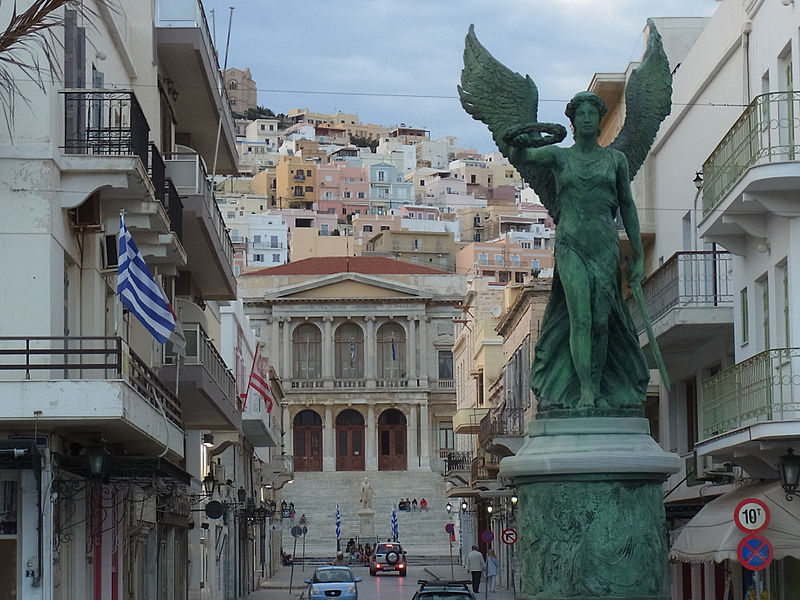
Nike, Winged Spirit Of Victory: A Statue Honoring The Resistance

Thank you and μπράβο Tantz. We need your story more than ever today, and we are lucky to have you telling it! 

Saturday, January 7, 2017

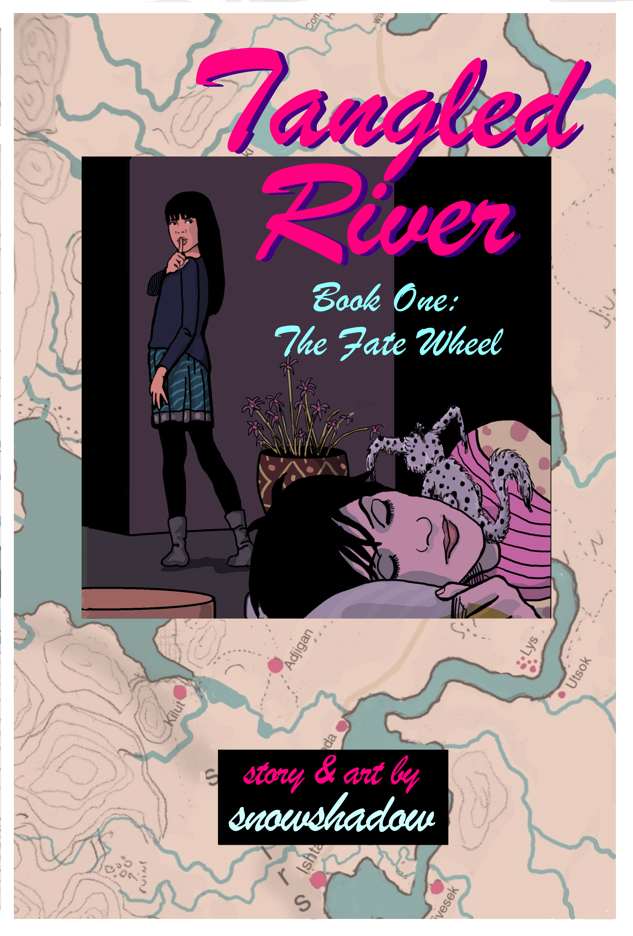
Saturday Revue January 7: Tangled River

Blast Off Into The Future With 

Worlds away and millennia hence, a young girl is trying to become a woman. It isn't easy for Tanya either. Technology brought from Earth is breaking down. School is boring, boyfriends on the settlement are rare, and her best friend may be dating AN ALIEN. And to top it all off, this settlement's last link with Earth has just been cut off. What a way to grow up!
Tangled River is the creation of the entity known as Snowshadow, and can be found at this link. 

The Rating


Looks like the educator gave you a B minus, Tanya. Not bad, but we've got some work to do.

The Raves


It was the writing that first captured my attention in Tangled River. This is one of those comics that truly captures the voice and thought processes of a young teen. Too many writers write either college students passed off as teens or impossible dolts, but Snowshadow has written young characters that are both relatable and believable. Tanya, the dutiful girl trying to be brave, is well balanced by her best friend Licorice, the wild girl who needs to learn some introspection. 
and they live in a well built and immersive landscape that is described through the actions of the characters. Pulling off a truly immersive world experience isn't easy, but Snowshadow gets very close to achieving it.

Both art and writing riff on the Golden Age Comics, with simple, classic storylines and an almost clinical approach to anatomy and color. Everything is direct, supremely clear and distinctive, with an interesting use of color. If the creator was going for nostalgia they've nailed it; you can practically feel the foolscap paper between your fingers.


 The Razzes

Unfortunately, if it hadn't been for excellent writing, I might well have gotten bored and wandered off. Why? Because the art had very little visual draw. It was well done, it was accurate...and that's all it was.

The Comic Color Is As Flat As The Paper

To a degree, color is a stylistic and subjective choice. But there are things to consider, and one of them is whether your color draws the eye.
There was a time when all comic color was flat, back in the Golden Age, but this wasn't intentional. According to Scott Beatty, "Printing before the advent of computers used two processes for separating colors into CMYK (Cyan, Magenta, Yellow and Black). One process was to shoot separations from the photograph or artwork with a stat camera, ending up with four pieces of film that could be stripped together onto a larger project. The other process, used by comic book companies to color their black line drawings, was to use overlays.
The technique was to use three pieces of acetate lined up on top of each other over the artwork page, each representing C, M or Y. Usually this acetate was rubylith, a product still used in screen printing today (to print on material and other substrates). Where the reddish film was cut away from the acetate ink would not print. Where the film was left ON the acetate, the camera negative would leave a blank spot, and ink would print."
This created good solid color, but it wasn't all that good at shadows. So, you ended up with work like this classic Batman (mis?)print. Hence the 'classic' look. Now, it's all well and good to go for the nostalgia of the style, but we're digital these days. We can do more than our forbears could, and if we want to catch a reader's eye, we have to. Right now the color palette of Tangled River is so muted and the shadows so pale that the eye wanders.
For example, this firelight scene.
It's fine. That's all you can really say; not anatomically incorrect, right angles, everything is...fine.
But let's do better than fine. Here's what can be done by simply upping the contrast a bit.

already, the eye is more attracted to the image. Now try adding some shadow. Shadow is how the human brain understands something is 'there' in the world, and shadows in art add weight and reality to objects. Without it, a deep part of your brain whispers 'that isn't really there, is it?' and this unspoken instinct colors your ability to be interested.
I timed myself for 5 minutes adding some very quick and dirty shadows with the Dodge/Burn tool to this image in Gimp, and got these results:

Five minutes shading and upping contrast to go from visually fine to visually fascinating. It's time worth spending.


The Reader Is An Observer, Not A Participant. Camera Angles And Focused Eyes Can Help! 

I had the same problem reading this comic that I used to have reading superhero works: the camera angles left me cold. Now, establishing shots are important, don't get me wrong. A good artist makes sure there are establishing shots to ground the reader in the world. 


But when every shot seems to be taken at one remove, a sense of distance grows up in the reader like a weed. We don't feel involved in even the most interesting scenes. This isn't helped by the fact that even the characters seem disinterested; often, their eyes aren't really focused on one another.  When drawing eyes, focus on focus! NImportant gives us a good example: the eye really should focus on the object it's viewing.

2)Less Perfection, More Emotion. Nobody Wants To Read About Mannequins


Thanks to Melaredblu for help on this infographic
They say a picture is worth a thousand words. Try this.

These are issues that crop up again and again, and are behind the sense that the art is good but not great. The characters seem more like posed mannequins than people. For more help in this area:
Anybody know who did this lovely tutorial?
  • read up on lines of action in animation
  • do some life drawing. It can be as simple as sketching in a coffee house
  • push your poses. Exaggerate things! 


The Revue

Not a bad first try at all. I look forward to seeing where it goes!

Sunday, December 11, 2016

Sunday Revue December 11:Fighting Dreamers

Look Out, Cat's Out Of The Bag! Better Call In The


Whenever something dreams, a universe is created. Thousands are spawned in a day.
But when these universes are under threat by monsters that aim to destroy them, warriors are needed to protect these universes. And that's where the Fighting Dreamers come in. The creation of nom de plume MannyKat8x, it's a romp. Leaping into dreams in peril, the Fighting Dreamers rescue our inner lands.
Oh, and did we mention that they're house cats?

The Rating

Quite the Cat's Meow!


The Raves

A clever take on the 'Inception' concept, 'Fighting Dreamers' has the cocky attitude of 'Top Gun', 'Agents Of SHIELD' and other scrappy-new-recruit works that catches the eye.
In terms of story, 'Dreamers' amuses at all times. The trouble a cocky new recruit doing dangerous work can get into is impressive, and all facets of the learning curve, both personal and experiential, are explored with a sour humor that will make you smile. I think many readers will see themselves both in the overconfident young breakaway Stewie and his superiors, who spend a lot of time smacking their furry foreheads with their paws.

The art is done in a loose, sketchy style and generally blue-shifted color palette that owes a bit to the styles of modern 'Cartoon Network' staples, though it has a feel all its own. The work focuses its emotional effects on exaggerated facial expressions to good effect. The feline teeth certainly help the impression along, especially in cases of annoyance.


The Razzes

There's several issues with this comic, but they may all stem from the same root cause: there's a slight case of creative myopia going on. The creator has focused so closely on writing Stewie's career that we're not really given an introduction into what he's doing as readers, only that he's doing it. Unless you read the 'about' section, you really don't know the reason for the monsters or the fight...and expecting readers to read the 'about' section is creative bad form.  That should be an extra treat, not a prerequisite.
Speaking of extra treats, there are some information pages, but they've been sadly neglected since the inception of the comic. We are reading comic works; informative blocks of text on the extra pages really aren't all that attractive. Even some decorative pngs would be a help!

In the art, there's so much focus on the face that the rest of the bodies seem neglected by comparison, with limbs delineated in simple straight lines. Don't get me wrong, the anthropomorphization is something I really appreciate.I'd love to see more work on the anatomy.

An actual cat's back and legs are very, very flexible, and straight lines don't do them justice. I'd suggest a little more work on matchstick outlines to capture more of a sense of motion. I'd love to see more work on integrating actual feline body language into the characters as well. A good example is below. 

The Revue

Purrrfectly sweet and  an amusing romp through dreamland. Well done!

Monday, November 14, 2016

Thanksgiving Intermission!


Taking a break until after Thanksgiving everybody! Go grab your snacks, have a chat, and it's on with the motley the Saturday after the Turkey. See you then!

Monday, October 31, 2016

Light The Fire, Gather Round! It's A Halloween Triple Feature!

All Hallow's Eve! When the darkness comes knocking, when the air smells of pumpkins and fallen leaves, it's time to explore the grim and the ghastly. Which is what we plan to do today!
Today, we'll be posting a Halloween Double Feature review of 'Patrick The Vampire' and 'Hopeless Maine', followed by a Monthly Matinee feature, 'The Masks We Hide Behind' after dark.
Snuggle down, dim the lights and hold on tight, Halloween has come to town!
And as an extra special gift for our Strip Show readers, here's four spooky Ray Bradbury stories. When the sun goes down, listen. Feel the turning of the world, and the shiver in your blood.Happy Halloween!
From The Dust Returned-https://www.youtube.com/watch?v=O0jW-MOCRWU
The Halloween Tree-https://www.youtube.com/watch?v=p09F0GXY7vc
Something Wicked This Way Comes-https://www.youtube.com/watch?v=XmGQ2IZCxmk
The October Country- https://www.youtube.com/watch?v=CNegOsA74j4

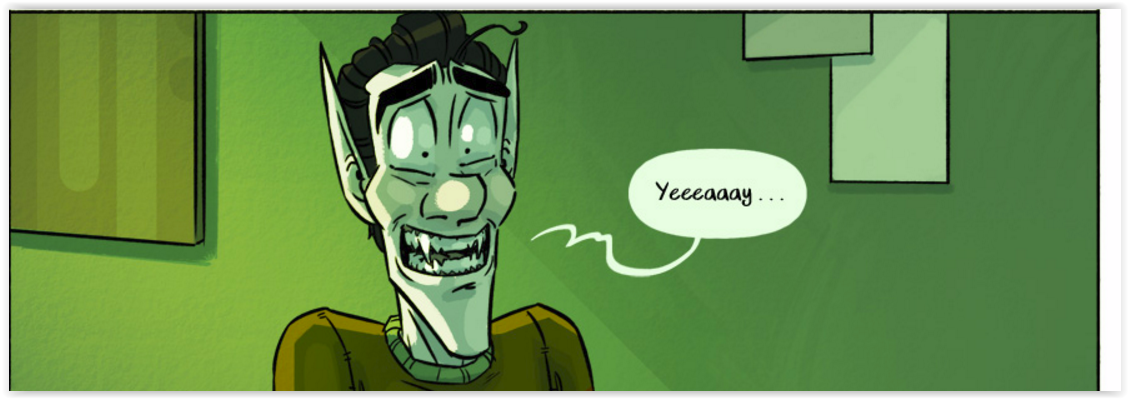
Halloween Double Feature Revue: Patrik The Vampire

Sink Your Teeth Into This!

Everybody's just trying to get by in life, really. You go to work, you pay your rent, you hang out with friends, you catch a guy down a back alley and drink his blood...

wait, say that again?
It's just another day in the life of Patrik The Vampire, the work of Bree Paulsen. According to Bree, 'Patrik’s a fun-loving guy who enjoys knitting and baking, visiting his friend Becky at the local coffee shop, and is a proud member of his neighborhood’s book club. He’s just a really nice guy trying to live a normal life.

Oh! And I almost forgot! He’s a vampire.'

The Rating

 Bloody good!

The Raves

From the earliest pages, this comic showed itself to have a wonderful grasp of writing style and the artistic chops to carry it off. The art and the script work together in seamless harmony, a deft sense of framing and imagery perfectly supporting witty one liners and snappy rhetoric, keeping us engaged with every page. 
The creator's pulled off the feat of creating a work that makes you think but still makes you laugh on a regular basis, and that's no easy trick. In the early pages, the comic is mainly a vehicle for well-done humor, but soon the story grows into something more: an exploration of personality, guilt, redemption and the longing we all have at some point in our lives to reach beyond our own lives and connect with others. Put plainly, Patrik wants so badly to make a friend! There are some deep themes in this  piece, but the writing and dialogue make sure that it never gets too heavy.  The art style helps keep the atmosphere from getting too dark: the loose playfulness of watercolor paints, the bright, chipper colors and stylized drawing flair keep what could have been a very grim piece in the realm of the cheerful, self aware comedy.
There's some solid characterization in this work: Patrick's desperate cheerfulness reminiscent of a recovering addict who desperately wants to prove that he can be a good man is wonderfully balanced with his two diametrically opposed best friends, one bitter as black coffee boiled too long in the pot, the other sweet and wholesome as a fresh baked cinnamon roll. Add in a cranky cat and a cute cast of background characters, and you have a recipe for a great comic.

The Razzes

I'll be honest. I've nothing to complain of. Hats off to you Paulsen! Personally I like to read the work on Taptastic because I find annoying Tumblr's habit of insisting that a click on the image means you'd like to see the image as a separate tab rather than going on to the next post, which is what I'm trained to do by most comics, but I understand that this is the fault of the platform, not the creator. In terms of art, writing, or workmanship, no complaints!

The Revue

Here's your Halloween treat, enjoy!


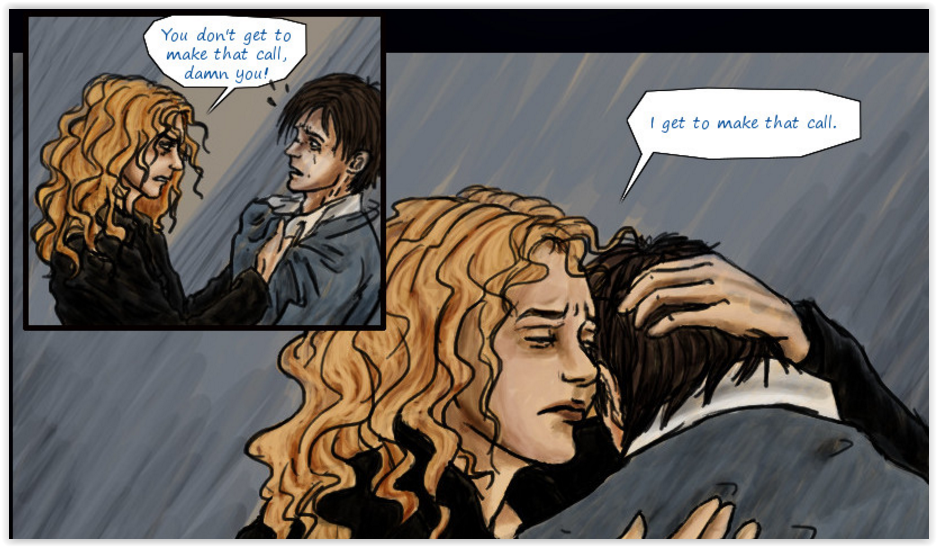
Halloween Double Feature Revue: Hopeless Maine

Are You Ready For A Story?

Listen Close, And I'll Tell You Of Hopeless, Maine...

So glad to have you come to town. Mind your step, you don't want to trip on a tentacle.Oh, her? She's the nanny for a local family. Didn't you know ghosts make the best nannies? Oh by the way, the town witch's selling curses at half price this week. Only the best quality of course. None of this mass produced plague rubbish.
Welcome to Hopeless, Maine. It was imagined by Tom Brown, written by a woman he ensnared in his imagination (she's now Nimue Brown) and ready to ensnare you....
According to the creators, 'The small island of Hopeless, off the coast of Maine, is a breeding ground for demons, freaks, vampires, and other creatures of the night. Our story follows Salamandra, a young girl with one foot in our world and one foot in the otherworld, as she navigates a life on the edge of reality.'
You were warned. 

The Rating

Spooktakular!

The Raves


Dark. Shadowed. Things you can't name moving out of the corner of your eye. In a word: atmosphere. This work has it in spades. Every panel, even the most mundane, has a sense of something shivering on the edge of your vision: something unseen, unnamed and all the more disturbing for it. And then of course there are the blatant dissonances with reality: the family (skeleton) dog, the dead nanny who sometimes forgets to hide the fact that her face is a skull. The neighbors sleeping in their coffins. The tentacles in the bay. All these things are accepted with perfect equanimity by the residents of Hopeless, lending the work an air of macabre magical realism reminiscent of Ray Bradbury's 'From The Dust Returned' and 'Something Wicked This Way Comes' as well as a hint of Neil Gaiman and Brom, a dash of Lovecraft, and a little Addams Family in there somewhere too.  It's a truly thrilling and beautiful work. Oh, and the characters are pretty thrilling too! The town witch, the preacher's son, the girl who plays with lightning, each of them is at once an archetype and a character in their own right; stubborn Owen, dreamy Salamandra, each with their own yearnings and kennings. 
The storytelling beautifully balances the mundane and the mysterious, playing on the unique human ability to accept almost anything as 'normal' if it's presented right. The storyline explores many of our deepest human motivations: to fit in, to have power, to feel safe. And it explores the dark uses those needs can be turned to: combine the need to feel like part of the group and the need to do something in the face of an event that makes you feel helpless-a plague, say- and you have witch burnings. Combine the fear of death and the invitation of a friendly smile, and you might just sell your soul.
But it's really the art that sells this fantastic and fanciful world where the veil between real and unreal has been shredded to ribbons and left to twist in the wind.


The Razzes

I would have liked to give this comic a ten, but there's a snag. The art's stunning. The writing's superb. But the reading platform? That flies like a lead balloon, and no amount of magic is going to make it less of a burden.
Here's what happens: You go to the Hopeless Maine site. You get a page with eerily beautiful illustration, an introductory explanation...and no comic. Puzzled, you begin to poke about. Under the 'books' section, you find a list, click one. 
Another beautiful illustration with a link to 'read the book here'. You're then redirected to a yumpu.com digital image of the book, and your torture begins. Click to read and you get an insanely blown up version of each page with text that's grainy. Not unreadable, mind you...but awfully close. It doesn't help that the text is somewhat crammed in its word bubble to begin with, but I believe the fault lies with the upload. The art's fared far, far better than the text has when being scanned in. You click again...and the image arbitrarily shrinks again because apparently you clicked the wrong spot. Surprise. The fact that you spend a lot of time mucking about with your mouse, frowning, clicking and frowning again to read each page or properly view each image....you begin to see the problem.
I can see the creators' reasoning: they want to sell books. They want you to see how beautiful the books are, but they want to give you a reason to buy the better quality version. All that said, as a reader if what I remember about your work is being annoyed, I'm less likely to buy it. Dear Mr. and Mrs. Brown, if something is to be hosted on the web, please make it easily readable on the web. It's a terrible amount of work to redo all that text...but it might just be worth it.

The Revue

A must read. Eerie beauty that shivers in your bones and sticks to your dreams. The perfect read on a Hallowed night....with all the candles lit.