Showing posts with label worldbuilding. Show all posts

Sunday, April 8, 2018

Sunday Revue April 8: Valley Of The Silk Sky

There Is A Valley Beyond Your Imaginings...

Enter  this valley, and you step into a new world. Do not apply your own rules or expectations here: they have no place. You are in a new place that plays by its own rules. Learn fast, or things might get a bit...
Dangerous...

The creator, Dylan Edwards, describes the story like so: 

Valley of the Silk Sky is a queer YA sci-fi webcomic for ages 13 and up. Follow the adventures of a crew of queer and trans scientists as they attempt to discover new medicinals, find lost artifacts, and generally try to avoid being eaten by the more dangerous denizens of the Valley.

Valley of The Silk Sky can be read here . Even better, it can be bought on Amazon, Gumroad, or read in many forms available at the artist's main site. 

The Rating

A glorious gem of a story, it only needs a touch of polishing.

The Raves


There is so much to love about the Valley. Especially if you have a scientific bent. Especially if you enjoy good worldbuilding. Especially if you're into adventures that don't ask you to leave your brain at the gate. Especially if you're part of the QUILTBAG  cohort. Especially if you like coming of age stories that don't beat you over the head with the message. Especially if...aw heck, you see where this is going.  
This is the perfect story for an adult and the tweens and teens in their lives to share. It's got enough action to hold an 11 year old's attention, enough nuance to interest an adult, and a really lovely sense of interpersonal humor. The creator has taken the leap that so few world builders dare to do, truly creating a world that is its own entity rather than an analog of our own. Many of the issues we expect to see reflected simply don't apply. That doesn't mean there aren't issues. Oh gods are there issues. But they are not the tired horses of bigotry that we have collectively beaten to death. Now, don't get me wrong, those issues should and do need to be addressed regularly, so that we can understand them. But it's so refreshing to see a story that lets us look at the world as it could be on the other side of the fights we're in today: a world where race and gender are such non-issues that they don't need addressing. The diverse groups of characters, human and otherwise, binary and otherwise, are shown as people. Simple as that. 
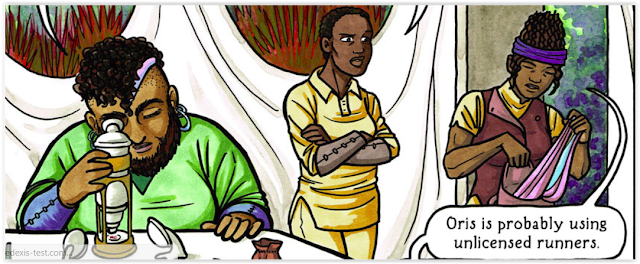
The characters in these stories have other things to worry about.
Things like bandits, invasive plant life and deadly predators. Oh, and misfiled paperwork. Lots of it. 
One of the things to love in this work is the relatability in the interpersonal relations and the situations. Strange as it is, we share the characters' frustrations with bureaucracy:
We laugh with them as they experience the wonders and the exasperations of cultural exchanges. And we give a sappy sigh at the power of friendship. Come now, you know you like to give a sappy sigh once in a while.

Another selling point: this story is clever. One of the plot points revolves around invasive plant species. Does the plant eat people? No, but it wipes out economically valuable native species and impoverishes communities by wiping out their livelihood.
*Leans forward over podium* Gentle readers, do you know how rare it is to find a story with a real-world issue that is not overtly violent being used as a main plot point? Especially one that involves the economic value of plant life?
Let me tell you. Vanishingly rare. Hen's Teeth rare. The bookish squeal of delight I let out when I read that scared my cat.

The clever use of science, ethnobotany, biology and architecture makes the world creation a character in its own right. Without beating you over the head at any point, the story subtly weaves its readers into a new biosphere with its own traits. I especially appreciated the nicely understated way in which the creator shows the view of the world through human and non-human eyes to make it clear that the world does, indeed, look different to us all. Especially if 'all' includes beings who see in heat signatures.
The story also makes us question our own assumptions in the best possible way. What at first glance to Western human eyes looks like an alien cheesecake art piece turns out to be a bathing ritual. Yep, Harakos clean themselves and each other the way cats do, with their spiny tongues. No sex involved. Get your mind out of the gutter, you!

I also devoured the chapter addendums, each of which is a witty and well-thought-out world building dissertation. No, this is not boring, dear readers. This is fascinating, and the perfect thing to read with your youngsters in order to get them interested in the underlying structures of their own world to boot. Of course you can always read it yourself, for the sheer joy of exploring new ideas. I know I did. 

The Razzes


The only thing that knocked this story down a peg was the art. Lovely and fascinating as it is, it's also got a bit of work still to do on creating anatomically natural moving characters. Too often, the characters are stiff, especially at a distance. They often seem to be missing joints as well, creating wooden arms and/or legs and a hard-to-pin-down sense of something 'off'.

I'd also like to see a smoothing out of the color washes. The general stylistic effect is nice, but in some areas the effect gets a bit too scribbly and could do with some cleaning up. 
The coloring issues can be aided by running a *slightly* dampened sponge over the color laid down by the marker, as long as the creator is using a water-fast marker for the linework. The body dynamics are best worked on by doing a little more with wire-frame sketches before setting down those final lines. And by that, I don't mean draw more wire-frames. Many, many great artists have used wire frame and still ended up with stiff characters.  Instead, focus on lines of action. 
Art By Patchy9
The line of action technique starts a character not as a series of blocks attached by lines, but as a single flowing lines with other lines radiating from it. The body shapes are then drawn in over these lines, and a character emerges.


Art By Matt Smith

If the creator would like to improve on their fluidity, I'd recommend working on line of action warm up drawings once a week for a while, and maybe working it into their art style.

The Revue

This is a great story. Hand it to your kiddos. Hand it to your nerdy buddies so you can geek out together. Hand it to your favorite biology-field folk. Hand it to some teachers, this would be great in a classroom. It has a lot to teach folks.
What you learn from it may surprise you.

Sunday, February 18, 2018

Sunday Revue February 18: Spidersilk

Draw Your Sword And Jump In With


 Spidersilk!


In this story, when they say 'thicker than thieves', they mean it. The motley crew of thieves who call themselves the Orbweavers spin their warp strings of adventure and intrigue across a weft of camaraderie and deep mutual respect. Oh, and a little romance goes into the decorative stitching too.
The creation of Alakotila, Spidersilk can be found at this link.


The Rating

A lovely little ramble through historic by-ways and crimes! 

The Raves

I'll give this comic two of my highest compliments: I had to force myself to stop reading in order to write the review, and I added this one to my personal reading list. Be aware, I do that rarely.
The story revolves around Prentice, a syphon (read blood mage) who builds his new life among a tribe of rascals and scallywags.

The story is delightful: by turns laugh-out-loud funny, tender and topped up with action, it's a rollicking ride. The romantic subplots are well and amusingly done, balancing tenderness with humor in a way that gives each relationship its own authenticity. 
The art style is a nice balance of skill and practicality: chapter pages and first pages are in well-done color, leaving the rest of the issue in sepia tone. I applaud the creator for striking a good balance between craft and speed: by doing work in this way they get to have their cake and eat it too. Oh, and speaking of cake, new thieves go through a training exercise of stealing cake from other thieves. The hilarity that ensues from that is enough reason to read. 
The creator is pulling on sword and sorcery fairly heavily for the world building basics, but they do so well enough that you question your own definitions of what each trope means as the characters do. Racial bias and the overcoming of it is one of the mainstays of the story, and it's well integrated, becoming neither a soapbox nor a narrative bludgeon but simply a nasty fact of our character's lives. And when there is action, it's both well planned and well drawn, both the amusing and the bloody bits.
All in all, I was quite a happy reader.

The Razzes

My biggest stumbling block to being a reader was the dialogue layout and general lettering. I can hear you wince from here, gentle readers. Yes, lettering, the bane of all comic creation.
But in the case of Spidersilk, there is hope for some fairly easy fixes!
Firstly, a little layout tweaking. Throughout the story, there are many pages where two small panels are offset by a larger vertical panel. 
This is fine, but if it's to be done, it must be done in a way that makes the eye flow easily. If the speech bubble on the right-hand panel bottom were the only one in that panel, this example would be perfect. But as the eye must return to the top, confusion ensues. Western minds are trained to read left-right, top-bottom. Change that and watch your readers wince. 

Working on the speech bubbles would also be a help. Many of them are a touch shaky and oddly formed, giving the reader a 'cramped' reading experience. I had this issue a great deal as a new artist myself.
But there is a fix for this!
I use GIMP as my main program, so I'll display it through that, but every art program I've heard of has a version of this process. 
First, create a transparent layer between the art and the type. For the purposes of this example and my laziness, I won't be re-typing the text to show. (by the way many apologies to the creator, I mixed up who's speaking in this panel and due to said laziness decided to leave my mistake in  rather than re-make the example. My sloth, my shame).
Using a very large setting on a white, round brush, create circles/ellipses around each text block.
By the way, try as much as possible to create complete circles. Speech bubbles that are cut off here and there harm the aesthetic of the page. A bubble that butts into the edge of the panel should be continued into the gutter. Make the gutter larger if need be, it's worth it.
Add your bubble tails with a smaller setting on the white brush. Then select your Wand tool. 

Select the entire transparent layer by clicking it with the wand tool. This will outline your bubbles in a dashed line.
Now, stroke the selection. (particularly approps for this story heh heh ;) )

Always stroke with the paintbrush or pencil tool set to the line thickness you want. This outlines all your bubbles in a nice black line. 

If you forget to use the paintbrush or pencil and simply stroke with the automated line size, the lines will be pixilated, as below.
If you did that by accident, never fear. Just hit 'blur', then 'cartoon' or 'photocopy', which will smooth out the lines.
And there you have it:quick, good looking bubbles! 

The Revue

A lovely wander through a well built world, with a few laughs along the way.

Saturday, March 11, 2017

Saturday Revue March 11: Hominids

For A Swingin' Good Time, Look No Further Than


Imagine Avatar re-written in an intelligent, soul searching manner. Imagine Tarzan with a brain. That, dear readers, is Hominids. Created by Jordan Kotzebue, this is the adventure tale you always wanted and never got. All the adventure, all the beauty, all the raw living power of the jungle is here, but this time there's a heart and mind to match. This story will steal your heart and entrance your eyes. Prepare yourself for a trek into a tale.

The Rating

A True Tale Spinning Feat.

The Raves

This rave must begin with the art. Gods, the ART! Lush, rich, vibrant and viridian, the artwork of Hominids is stunning. The creator is truly a master of their craft, capturing body language, expression, lighting and atmosphere with a breathtakingly deft hand. The color of a flower, the light on a leaf, the gleam on a blade all draw the reader eyes-first into a living breathing ecosystem. You can almost smell the loam and leaves, breathe the humid fragrances of strange flowers and sweat and feel the grass between your toes. This art is exemplary.

But beautiful artwork is only the first strand of the web. Onto the storytelling, which is more than a match for the art!

Hominids is aptly named, for it is, in effect, a story about people: their loves, their hopes, their dreams, their motivations, and what circumstances and culture can make them into. Angel or monster, heathen or heretic or high priest, it has nothing to do with who you are and everything to do with who your culture THINKS you are. The best people can be twisted into beasts by a culture with a domineering mentality. And the angriest people can be eased by a culture that focuses on peace and cooperation. Hominids is a parable about interacting cultures on one level: what has in other places been called 'the dance of the givers and the takers' is portrayed here. Cultural interaction between cultures with entirely different priorities can very quickly get problematic.

On a creative level, you can't help but be impressed by the creative worldbuilding and scientific dedication that went into this work. For instance, the ecosystem is based on and in some cases drawn directly from anthropological research on what various branches of the human family tree might have been like, and exploring a time when we coexisted is FASCINATING. The subtle attention to plant and animal species appropriate to the setting really impressed me (being a horticulturist in my professional life, people who get plants right make me happy!) and there are many deft and subtle bits of ecological and evolutionary design: for instance, the tree dwellers are perfectly designed for their forest home. They even have dappled patterns on their skin that aids them in concealment. THAT impressed me. This creator did their homework!

 On another level, this is a story about the interaction between individuals and the moral code of their culture. In Hominids, people ask eternal questions: do I believe what I was taught? Was I brought up with the right beliefs? What if there's another way? As the characters ask themselves, we're all encouraged to ask these questions along with them, and we all grow stronger for it.

But wait, there are still more layers! There is a spicing of sci-fi hidden under the fantasy of this tale, a hint of an older and far more technological civilization hidden under the vines and creepers, metal under the jungle loam. Now what happened here, the reader must ask. What indeed...

But that hint will remain, for now, just a hint. This vibrant ecosystem of story works holistically: none of these elements jar or push out the others. It's part of what makes such a complex story work.
 Another key element is extremely strong writing. The dialogue is crisp, clean and believable, the story moves along at a perfect pace, and there's just the right amount of pleasant, sweet and amusing banter mixed in to keep the story upbeat in the face of deep, difficult and complex themes.

In a true master stroke, every single character is well-rounded, strong and believable in their motivations: serious homework having been done is evident again in the careful use of psychological motivators, but this story reads as a STORY, not as a text book, and that's what takes it from good to great. You can understand and sympathize with every single character, even the ones you despise. And that is true greatness in storytelling.


The Razzes

There's not a lot to be said against this comic: it's stunning. But a few little areas could use some polishing up.
First off, dearest creator, when you've made something as AMAZING as this it doesn't deserve the rookie mistake of missing a page favicon. I'd add one as soon as possible. As a reader I noticed this little detail when, flipping through the tabs on my taskbar, I couldn't find the one for Hominids at first. Because it had a blank favicon that looks like any other neglected waif of a page. Let's fix that!
Simply put this code into the header of your site's HTML: 

<head profile="http://www.w3.org/2005/10/profile">
<link rel="icon" 
      type="image/png" 
      href="http://example.com/myicon.png">

and replace 'example' with the url where you store your image. Done and dusted. Your icon should be 160 by 160 and say something about your page....for Hominids, might I suggest a leaf?
The only other thing I might suggest is a little work on tangent lines and dialogue layout. Occasionally the reader's eye is confused about the direction of speech in a conversation. The creator has color coded the speech, which helps enormously, but careful attention to word bubble placement is still essential.
Always remember that English readers read up to down, left to right. Throw that off even a little and you have confused eyeballs.

The Revue

A wonderous and enchanting MUST READ. Fern Gulley for adults, Avatar for intellectuals. Enjoy!


Friday, January 13, 2017

Backstage Pass January:Tantz Aerine

Psst! Slip Behind The Curtain! Here's Your Backstage Pass!

And Just Look Who's In The Dressing Room! It's Tantz Aerine!

In a time when the world seems a little dark and quite a few people are throwing around the terms 'Hitler' and 'Nazi', here's a creator brave enough to tell the true stories of Nazis, Resistance Fighters, and what it really cost to fight for the soul of your country.

Tantz, will you introduce yourself?


I’m Tantz Aerine (IRL Tanya Geritsidou), a Greek psychopedagogue born in Quebec, Canada. I specialize in educational policy and have a background in psychology and a long experience in teaching methods. My science aside, I’m also a professional author, mostly of high fantasy. I’m most known for my high fantasy trilogy The Art of Veiling,
but I also write short stories and scripts. The past near decade I also am very seriously invested in creating webcomics, mostly graphic novels.

Main Projects 

My main webcomic project is Without Moonlight, which is definitely one for the long road.
WM is basically a tour of the visceral underbelly of Greece’s modern history starting with the occupation by the Nazis (and their Italian and Bulgarian allies) during WWII, and, if I am able and live long enough, reaching up to the 1980s, in successive volumes-units as the story advances and characters come and go. All of it I plan to explore through Fotis, who is one of the main characters.  It’s his life we follow, hopefully until he becomes an old man. I say hopefully, because sometimes the story surprises even me, and Fotis might give the torch to someone else to carry on to the 80s, through all the torrential, extremely dangerous circumstances of Greek modern history.

Other Hobbies, Guilty Pleasures and Obsessions


I love baking cakes, coffee cakes… basically any kind of dessert.
My guilty pleasure has to be binge watching series.
I’m not sure about obsessions actually… unless… well, I want to keep my activism out of this interview, but you could say I’m obsessed with having International Law and Human Rights actually applied to everyone without exception. A simple adherence to these laws would solve immediately an astounding amount of problems. It just wouldn’t help the minority we all know make money as it does anymore.

So, tell me about your early experience. How did you fall in love with telling stories in pictures?

I always loved to draw and expand my drawing skills. I’m self taught, so that entailed me basically doodling everything and at all times. When I was in high school I had a large notebook where I wrote my stories, and a lot of loose papers where I doodled my characters and other things I found interesting.
I used my cartoons and general love of sketching in my classes as a teacher, in various ways to keep the children engaged and motivated. That led to me making short comics of my students as characters in stories that they built over the week, serving as their reward for their hard work.
And well, one thing led to another…

What media and programs do you work in to produce your project?

Up until recently, I used Photoshop. But then the program got corrupted and wouldn’t run in Windows 10, so I was obliged to transfer to GIMP.
I work 100% digitally: GIMP + Intuos tablet.


Can you tell me about your typical day or strip-creation session? How does your work process flow from idea to finished page?

The plot for WM is already sketched out and complete for the entire project, as I said barring any unexpected twists or turns the characters might throw my way.
I have the script for the next few scenes already penned down (so that’s about 2-3 months’ worth of updates, assuming I update once per week).
When I feel ready to sit down and make a page, I re-read the scene I’m currently making to get in the mindset and the mood I’m going for. Then I make the layout of the page, by matching lines to panels: that way I know how much of the script is going on the page, and how I’ll illustrate it (i.e. how many panels, angles, etc).
Then I work linearly, going at the first panel of the page and finishing it completely (i.e. colour and lighting) before I go to the next one. So by the time I’m finished with the final panel of the page, the page is also finished and ready for lettering.
The entire process usually takes about 8 hours. I like to be able to make a page in one sitting but usually with my obligations I work in 4 hour sessions over two days.

What’s the most difficult part of your work?

A big part of my comic is dialogue- characters talk and argue and fight. The action is intense but in short bursts, just like in real life. Things happen very fast and with absolute effects, but they don’t happen all the time. In between, characters run around and ruminate to be able to set up the circumstances so that they will win next time, in the next action burst.
So the hardest part of my work is to avoid talking head syndrome. I want the talking to be just as intense as the action and engage the reader, and that has to happen through body language and the nuances to be discovered as the characters talk.

Can you tell me about your storytelling process? Do you prefer to script your stories, fly by the seat of your pants, or somewhere in between?

I prefer to have my script ready by the time I put pen to tablet, and that’s because my story is basically a historical graphic novel. I can’t afford to fly by the seat of my pants, because I have to be certain everything is as accurate as possible in terms of the story fitting the history.
I had made a comic, Wolf, 100% flying by the seat of my pants, and it was super fun! It also helped me learn how to make webcomics and for that I’ll always have affection for it, even though it’s ghastly art wise.
But Wolf was a bio-science thriller story in a fictional contemporary city, and I felt I had free hand to do what I wanted without anyone fact checking on it. WM on the other hand, isn’t nearly as forgiving.

 I have to make everything just right, fit it just right so the story would plausibly be one that could have happened in 1942 Athens, time it just right to hit the dates I have to hit, so I feel I have to have good control of the story. Hence, script is necessary

How much of a buffer do you like to keep?

Ah… I would like to keep 2 weeks’ worth of buffer (i.e. about 3-4 pages). I have never managed it. I work with no buffer, and my readers understand that I make a page as quickly as I can, and upload it immediately.


Has anyone told you that you'll never be a successful artist and you'd be better off studying a real field and/or getting a real job?

No, but that is probably because by the time I started making comics and being an artist (including my author side) I already also had my degree and worked a ‘real job’. So I did used to get a bit of shade or side looks, but nobody felt they had the right to tell me anything. I think though that the times are different than the 90s and the 00s. Especially since ‘real jobs’ don’t pay as much lately either, what with the global recession craze, and a successful freelance artist might be in a position to make the minimum wage at least.


What message do you hope readers take away from your work?

“There’s so much more to history than what I’m taught in school, and it might give me new insights about the world!”
“There’s more to Greece than her ancient history and her contributions to the world continued beyond Alexander the Great.”
“War isn’t just the battle theaters of the fronts, but also the occupations, the devastations, the silent annihilations that don’t make the news.”
“Fascism rhetoric is uncannily current and way too modern to feel at ease that it is dead. There was a time where the swastika was just another flag among the rest.”

So much of your story is historical in nature: how do you go about researching it? What's the research to art-making  ratio in your work?

I prefer direct sources to secondary ones. Those aren’t very easy to find if you don’t know where to look.
Greek boys who were part of the Athens Resistance

For that reason, I did most of my research (and bibliography compilation) before I even started creating the plot, let alone the script or any page.
Accounts of what took place in Greece during WWII (and especially during the occupation which is when WM begins) are abundant but relatively superficial if you try to research the daily life of the people in the cities and in the country, the smaller events that took place, etc. History, when packaged for international audiences, tends to record only big hallmarks, such as the first ever sabotage in Europe that took place by the newly formed resistance in Greece, but neglects to document the daily smaller events of resistance, such as demonstrations of unarmed people against fully armed Nazis, the food-supplement network to battle famine, and a lot of other things.
So what I did was go right for the direct accounts and records of the events as recent to them as possible. I began with state archives of the impact of the occupation in Greece, compiled by the ministry responsible in 1947. Then I researched all the documentation printed and issued by resistance movements of the time. I have books and newspapers that used to be illegal at the time (on pain of death) documenting stuff about daily living and other issues that I wouldn’t otherwise know.
I also have big collections of photographic evidence of the era, ranging from photos of atrocities to photos of daily living (e.g. a picket of Nazis at a tavern having lunch, with some other Athenians sitting around in other tables numbly, and so on).

An Athenian being harassed for the amusement of Nazi soldiers
I also have collections of propaganda and anti-propaganda, newspaper clippings and front pages, posters, you name it.
I keep researching though, and every new source or document that falls in my hands, I collect and keep. Sometimes I even adjust my story’s plot to incorporate it, or just make sure to illustrate it in the background.
Methods of research to amass all of that include of course intense internet research but also a lot of diving in old bookstores that specialize in old authentic books and newspapers (there are a lot of those here in Athens), attending events presenting such evidence, interviewing survivors (some are still alive today), going out at the actual places where WM takes place and taking photos (the city center hasn’t changed since 1930), and then looking for the changes in the areas of Athens that HAVE changed, so that I may depict Athens during the 40s as faithfully as possible.
How do you go about doing your research? What are some of your favorite sources?
Favourite sources (newspapers and clippings aside) include:
(in Greek)
    A Greek soldier holding his daughter

  • The Greek Resistance, as revealed by the secret archives of Wehrmacht in Greece by P.K. Enepekides (1964) (also available in German)
  • Greece under the Swastika, documents from the German archives, edited by Martin Seckendorf (also available in German) (1991)
  • Testimonials Regarding the Greek Resistance, by D. Gyftopoulos (1984)
  • Light in the Darkness of the Occupation, National Resistance 1941-1944, Heroism & Sacrifice, Decadence & Treasons, by N. Antonakeas (1947)
  • White Bible, May 1944 to March 1945, by E.A.M. (National Liberating Front) (1945)
  • Photos of the Occupation, photo evidence from the German archives about the heroic resistance of the Greek people, by V. Mathiopoulos (1980)
  • (in English)
  • Hitler, a biography, by V. Ulrich, (2013)
  • Report of the FAO Mission for Greece, by Food and Agriculture Organization of the United Nations (1947)


Partisan fighters lauded in their home town in the mountains
One thing I really want to mention is that the older the sources, the more emotionally charged they are, and the more politically skewed they are. I have sources written by royalists, by communists and by democrats, all giving accounts of the same events. All of them try to support their take on those events by documents and other evidence. It is fascinating to see not only what happened at the time, but how much and how viciously political parties vied for power over the interests of the Greeks or Greece herself- and just as heartbreaking and touching to see that all the people in all those groups were shedding their blood for the very same cause, unaware of the political machinations of the few in every political party’s top tier.
I strive to demonstrate that in my comic. It’s too early yet to see more than hints, but I will touch on that directly soon.


You deal with very difficult source material; are there things that you get nervous about discussing? Is there anything you've ever decided not to depict?

A partisan girl strutting her stuff
Right at the beginning of WM I was attacked for being unfair to the Nazis and ‘depicting them in a negative light’ (I kid you not). Very vehemently might I add. After that, I have no nervousness depicting anything, simply because the subject matter is such that some toes will be stepped on, no matter how careful I am. So I’ve decided to just depict things are they were and not beat around the bush.
As for anything I’ve decided not to depict- yes. I have decided to sanitize the atrocities some. You can’t believe the stuff I have read and seen in the photos. It’s so grotesque and insane, so extremely sadistic and evil that I’m positive no person would believe me if I depicted such things in the story. So I have toned down the manners of punishment and manners of reparations where I felt it would come across as too fantastical and a fabrication rather than historical fact. I also don’t think I have it in me to draw such things. They hurt too much.


What keeps you devoted to telling the story you’re telling?

My love of my own people, and a need to showcase as much as possible their acts of immense heroism in the face of unthinkable odds and stakes- it’s time they stopped being unsung, at least as much as I can help it.
But aside that, I also wish to show to the world what happened not too long ago, and get across the feel of day to day living in such circumstances, the rhetoric of those circumstances and how easily, how silently, how suddenly we may wake up to find ourselves in the same or similar situations. It’s my bid to warn, to plead for these things not to happen again, as unfortunately they’ve already begun being applied.
Finally, WM is a story that I intend to end with the optimism that these people had through all the adversities, and that I still have about humanity. No matter what, we will prevail over the darkness of the world.
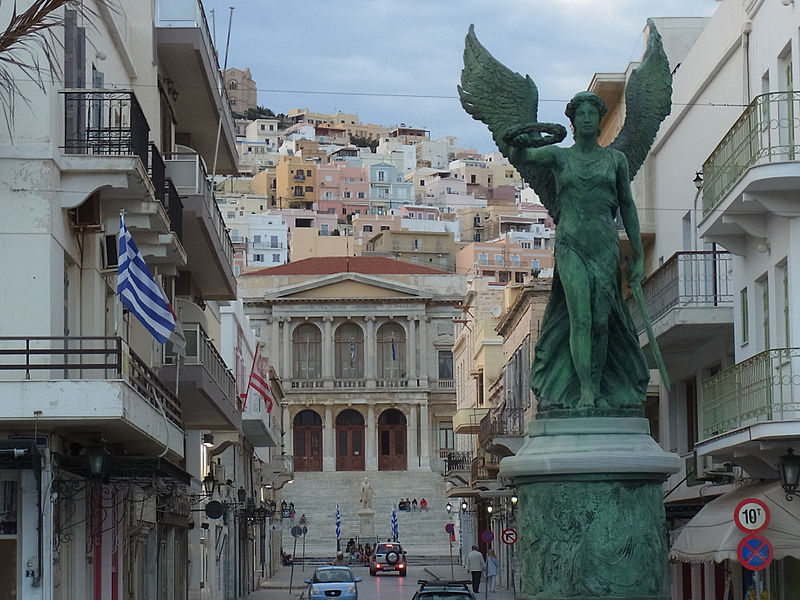
Nike, Winged Spirit Of Victory: A Statue Honoring The Resistance

Thank you and μπράβο Tantz. We need your story more than ever today, and we are lucky to have you telling it!